

Seamless information flow
Ensures work progress, issues, and payroll and billing information are accurately and efficiently shared between your office and field teams.
Keep projects on track
Identify issues, track potential change orders, and ensure that any cost or schedule impacts are tracked and communicated to all project partners.
RFIs
Track the progress of RFIs and get your team the information they need.
Submittals
Track the submittal status, type, and due date for every project and who you are waiting on with the ball-in-court workflow.
See what HCSS can do for you
Schedule a demo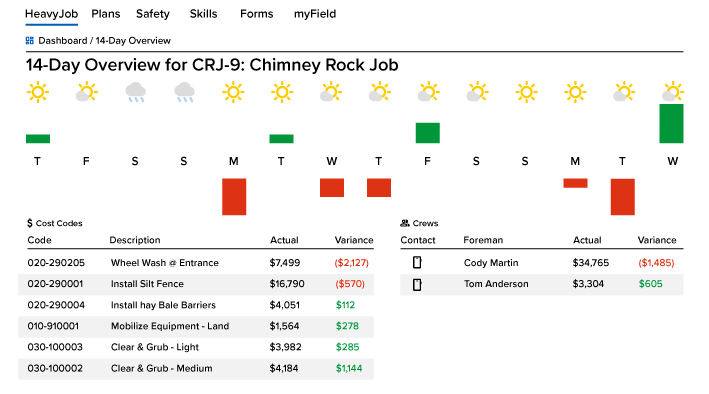
Ask our customers why they trust HeavyJob as their project management tool






It lets me know where projects are and where problems might be.
- Tim Klass, Sigfusson Northern Ltd.
We’re moving away from the DIS and going directly to API, and working with your team has been phenomenal!
- Corwin Fontaine, Allan Myers
95%
of HeavyJob projects close within budget
128,000
active HeavyJob users
9.4/10
average user rating
Always-on support.
Always human.
- Guided implementation to get your team up and running faster.
- Award-winning 24/7/365 support from our Sugar Land, TX office.
- Dedicated Customer Success rep to guide you beyond go-live.
- Ongoing training through HCSS Academy and HCSS community
See how to collect better field data with less effort and instant insight
Step 1
Share your business headaches
After submitting a demo request form, an HCSS expert will follow up with you by the end of the next business day to discuss your business needs and requirements.
Step 2
See HCSS in action
Then, we’ll walk you through a demo tailored to specific HCSS solutions that can help solve your current business problems.
Step 3
Get up and running in days
Finally, you’ll be assigned a dedicated implementation specialist who will manage your implementation from start to finish and ensure project completion.
Frequently asked questions
What is construction management software?
Construction management software is a digital solution that helps contractors plan, track, and manage their projects from the field to the office.
It replaces spreadsheets and manual processes by giving teams a centralized system to monitor job progress, track costs, and coordinate work—helping ensure projects stay on schedule and within budget.
What does construction management software actually help contractors do?
Construction management software helps contractors track job progress, manage crews, capture field data, and monitor costs in real time.
With HeavyJob, teams can record time cards, log daily activity, and communicate updates from the field—giving the office immediate visibility into how jobs are performing and where adjustments are needed.
How does construction management software connect the field and office?
Construction management software connects the field and office by capturing data at the source and making it instantly available across the entire team.
With HeavyJob, field crews enter time, quantities, and notes directly from the jobsite, giving project managers and office teams real-time visibility into job progress, costs, and performance—without waiting on paperwork or manual updates.
How does construction management software improve project profitability?
Construction management software improves project profitability by giving teams real-time visibility into costs, production, and performance.
With HeavyJob, contractors can track actual costs against budgets, identify issues early, and make adjustments before they impact margins. This helps reduce costly surprises, speed up billing, and keep projects financially on track.
Why do contractors switch from spreadsheets or manual processes?
Many contractors start with spreadsheets, paper forms, or disconnected tools to manage their projects, but these methods often lead to delays, errors, and limited visibility into job performance.
With HeavyJob, teams replace manual processes with real-time data capture and centralized tracking, eliminating communication gaps between the field and office and giving them the information they need to run projects more efficiently.
How does construction management software integrate with other systems?
Construction management software integrates with systems like accounting, payroll, and estimating to ensure data flows across your operation.
With HeavyJob, field data such as time cards, production, and job costs can be shared with other systems, reducing double entry and improving accuracy—so teams can spend less time managing data and more time managing projects.
Didn’t get all of your questions answered?
Request info