

Track over-budget line items
Identify line items that are over budget and use scenario planning tools to get your projects back on track.
Job forecast calculations
Calculate job progress and projections for cost at completion based on productivity data, and make manual adjustments when necessary.
Forecast dollars to the crew level
Use your time card information to change production hours and calculate different per-unit costs for the remaining quantities.
Generate forecasting reports
Quickly create reports based on budgeted dollars, forecast remaining, and differences from your bid so you don’t have to reinvent the wheel using spreadsheets each month.
See what HCSS can do for you
Schedule a demo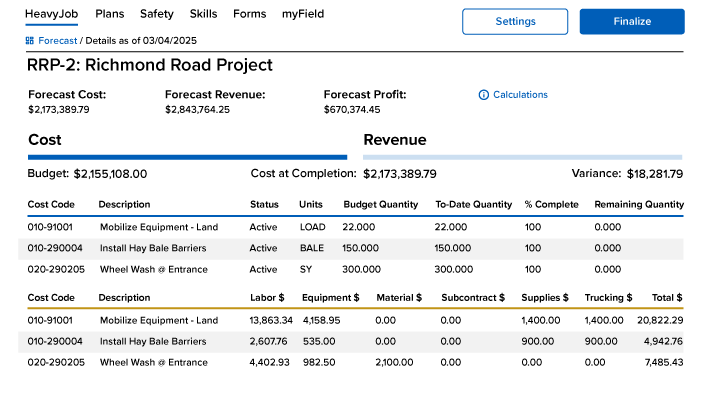
Ask our customers why they trust HeavyJob for accurate field data






We figured out how to manage contingency and how to enter risk into our financial reports.
- Julia Salgueiro, Preston Companies
It’s transformational in how we make decisions about running our business.
- Jake Anderson, The Walsh Group
95%
of HeavyJob projects close within budget
128,000
active HeavyJob users
9.4/10
average user rating
Always-on support.
Always human.
- Guided implementation to get your team up and running faster.
- Award-winning 24/7/365 support from our Sugar Land, TX office.
- Dedicated Customer Success rep to guide you beyond go-live.
- Ongoing training through HCSS Academy and HCSS community.
See how to collect better field data with less effort and instant insight
Step 1
Share your business headaches
After submitting a demo request form, an HCSS expert will follow up with you by the end of the next business day to discuss your business needs and requirements.
Step 2
See HCSS in action
Then, we’ll walk you through a demo tailored to specific HCSS solutions that can help solve your current business problems.
Step 3
Get up and running in days
Finally, you’ll be assigned a dedicated implementation specialist who will manage your implementation from start to finish and ensure project completion.
Frequently asked questions
What is construction forecasting software?
Construction forecasting software helps contractors predict future costs, timelines, and project outcomes based on real job data.
Instead of relying on estimates or assumptions, teams can use current performance and historical trends to plan ahead—giving them a clearer picture of where a job is headed and what adjustments may be needed.
How does construction forecasting work?
Construction forecasting works by combining current job data with historical trends to project future performance.
With HeavyJob, teams can adjust quantities, costs, and productivity assumptions to model different scenarios and understand potential outcomes. As new data comes in, forecasts update automatically, giving teams a dynamic view of how the job is likely to perform.
How is forecasting different from job costing?
While job costing shows how a project is currently performing based on actual costs, forecasting helps teams predict future outcomes.
With HeavyJob, job costing provides real-time insight into current performance, and forecasting uses that data to project future outcomes. Together, they give contractors a complete view of both where they are and where they’re going.
How does forecasting help prevent budget overruns?
Forecasting helps prevent budget overruns by identifying risks before they impact the project.
With HeavyJob, teams can see where costs or production are trending off track and make adjustments early—whether that’s reallocating labor, adjusting production plans, or updating budgets. This proactive approach helps avoid costly surprises later in the job.
How does forecasting improve project profitability?
Forecasting improves project profitability by helping teams make better decisions before issues impact the bottom line.
With HeavyJob, contractors can plan more accurately, allocate resources more effectively, and adjust strategies based on projected outcomes. This leads to stronger margins, fewer costly surprises, and better overall financial performance.
How does forecasting use real-time job data?
Forecasting uses real-time job data to ensure projections stay accurate and up to date.
With HeavyJob, inputs like time cards, production quantities, and job costs feed directly into forecasts, allowing projections to update continuously as work progresses. This gives teams a more accurate, real-time view of future performance—without relying on outdated spreadsheets or assumptions.
Didn’t get all of your questions answered?
Request info