
McGuire & Hester has spent a century self-performing heavy civil work across the Bay Area, but one disconnected system or unstructured time card is enough to turn an AI agent's answer into an expensive guess.
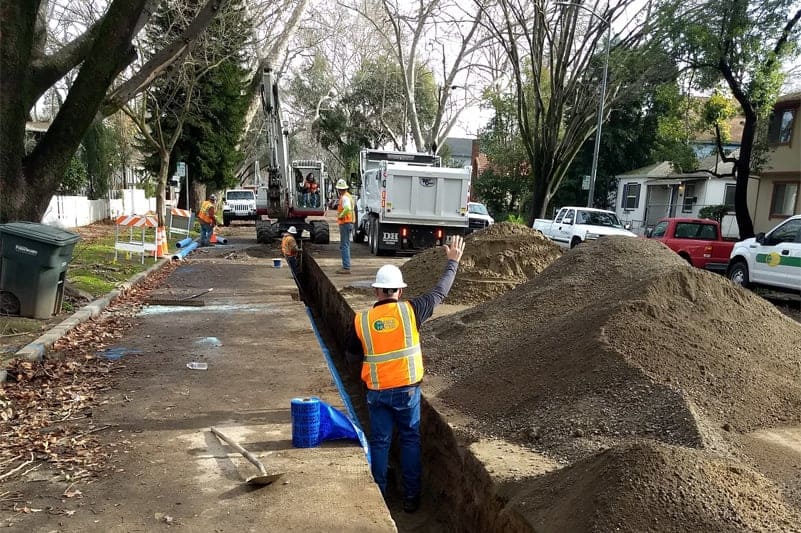
Construction generates more operational data than almost any other industry: time cards, telematics, fuel logs, production quantities, and photos from every jobsite, every shift. Most of this data gets entered once and is never looked at again.
That’s the problem McGuire & Hester, a self-performing heavy civil contractor marking its 100th year in business in the Bay Area, has been working through for the past year. Michael Ridino, the company’s Director of Information Systems, leads a lean IT department responsible for every system the company runs (as well as overseeing every vendor the company brings in).
His take is direct: agentic AI is only as good as the data underneath it. Like much of the industry, McGuire & Hester is actively building the data and integration foundation needed to scale AI responsibly, and the company has chosen to put that foundation in place first.
"Moving ones and zeros by humans is just really expensive, especially here in the Bay Area. In 2026, most applications should be at a minimum using APIs. My job is to only bring in vendors that enable that. The less friction we can have in the system, the quicker we can turn around answers and get it to the people who can make those decisions."
— Michael Ridino, Director of IT, McGuire & Hester
The Issue: Data that Evaporates
A year ago, McGuire & Hester was right in the middle of exploring AI. Today, the company has a handful of pilots running, with one or two tools already in production. That is real progress, but it’s still not a finished transformation, and Ridino is upfront about that. Legacy construction software was built for people to click through, not for AI to read, and the systems that hold estimating, field, and accounting data were never designed to talk to each other.
The bigger risk that McGuire & Hester encounters is a market flooded with vendors bolting AI onto a product for a headline moment rather than building it on a governed, structured data foundation. This is why the company came up with a simple filter for telling the difference: does the vendor treat openness as a real requirement or as a talking point?

The Solution: AI-Ready Data
Michaela Halliwell, Group Product Manager for Platform Data, Integrations, and AI at HCSS, frames AI readiness around four traits: Data has to be 1) granular, 2) structured, 3) connected, and 4) governed before an agent can be trusted with it. McGuire & Hester ranks them the same way most contractors would if they were honest about it.
“The easiest is granular,” Ridino says. “People will store gigs and gigs of data when there’s no cost to it.” Structure comes next, and it matters more than most companies realize: point AI at unstructured plans and specs, then it will immediately start guessing. Connected, he says, is the hardest by far, because it means physically opening up systems across departments, vendors, and firewalls.
That belief shows up directly in how McGuire & Hester buys software. Every vendor, HCSS included, gets the same questions:
- Is there a real, published developer or API portal?
- Can Ridino get his own data out in a usable format?
- Will the permissioning model respect the roles he has already set up?
- Is the vendor moving toward open standards like MCP (Model Context Protocol)?
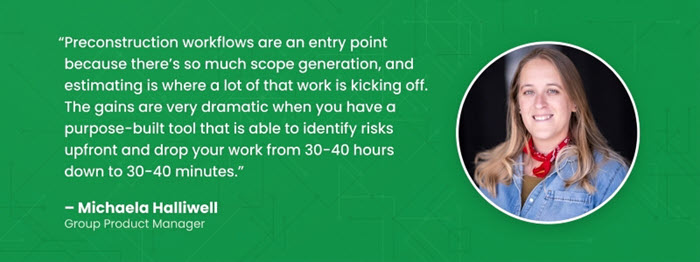
Estimating and preconstruction are where McGuire & Hester sees the clearest payoff. Document review and takeoffs are heavy, repetitive work, and they are the first place a purpose-built tool can compress hours of manual effort into minutes. But none of that works without the fourth trait: governance.
McGuire & Hester’s rule is that an agent inherits exactly the permissions of the person running it and nothing more. Payroll, HR, and safety data are deliberately kept walled off. Ridino tests this himself, asking enterprise chatbots for a senior leader’s driver’s license number just to see whether they refuse. “It should not tell it to you,” he says. “If it does, you have a problem. But AI will quickly expose all of those issues, and it can also be used to solve them.”
The Outcome: A More Intentional Path to Agentic AI
The result so far is not a single dramatic before-and-after, and McGuire & Hester does not present it that way. The rollout is more intentional: moving beyond broad, low-stakes chatbot access toward specific tools designed to free up time for estimators, field staff, and back-office accounting. This habit means stress-testing new tools for governance gaps before trusting them with real workflows. Setting that bar for vendors, early and held consistently, pushes every piece of software McGuire & Hester buys a little further toward openness.
What is still ahead is the bigger ambition: fully closing the loop, so that a bid becomes a job, a job becomes an actual, and the actual feeds directly back into the next bid without anyone moving data by hand. Ridino calls that the real prize, and he remains assertive that McGuire & Hester is not there yet but will be.
Why This Matters Beyond One Contractor
Halliwell is equally candid about where HCSS fits in this. “Companies like HCSS are not Anthropic and OpenAI, and we are not going to pretend to be,” she says. The vendors positioned to help contractors are not the ones with the flashiest model, but the ones who treat APIs, structure, and permissioning as core product work rather than a feature checkbox. “There is no AI without APIs,” she says. “There is no intelligence without APIs.”
That is the same standard Ridino holds every vendor to, and it’s why McGuire & Hester’s story is more about the groundwork that has to happen before AI can be truly successful. A lean IT department without a self-hosted model or a dedicated security team can still get AI-ready, but only by being deliberate about structure, insistent about openness, and conservative about governance, in that order.
Get Your Data AI-Ready
Agentic AI is only as good as the data underneath it. See how HCSS builds an open, API-first, governed data foundation into HeavyBid, HeavyJob, and the rest of the platform, meeting the same standard McGuire & Hester hold every vendor to.
Schedule your demo with a product expert today.