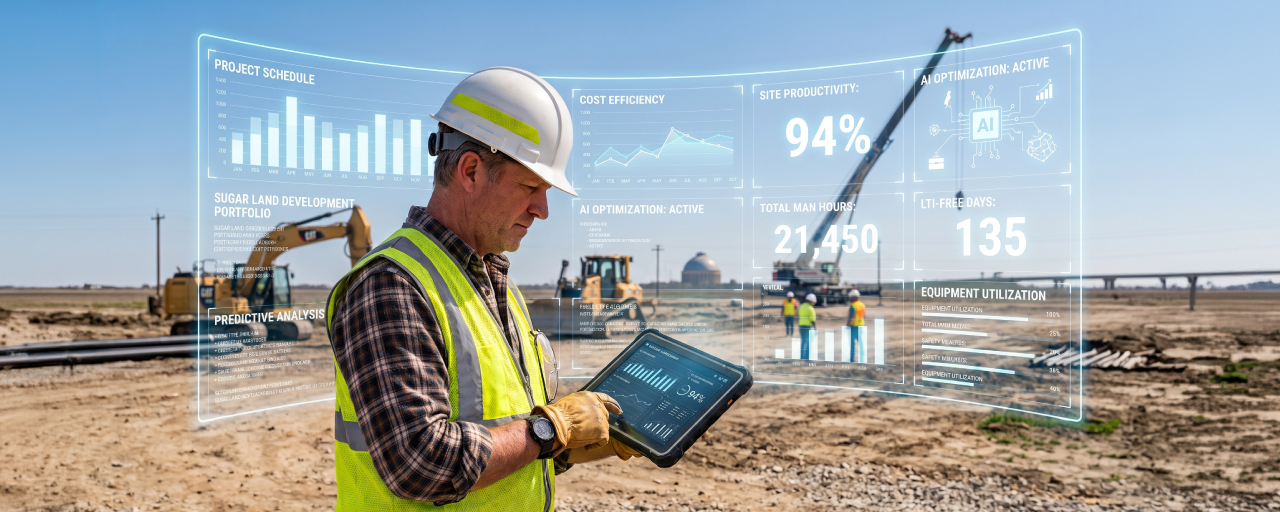


Consider a common scenario across modern jobsites: a project manager (PM) inputs an aggressive email from an owner’s representative into a public LLM to polish their response. The tool outputs a refined draft seamlessly. However, operational friction occurs when the PM asks the same model to interpret complex subgrade preparation specifications or reconcile a pay item discrepancy against a previous monthly application.
Without access to your proprietary specifications, historical project data, or cost codes, general AI degrades into hallucination—and actionable intelligence shouldn't depend on prompt engineering expertise. This disconnect illustrates precisely where construction-specific AI yields optimal returns: automating data aggregation and information retrieval, while empowering expert oversight.
For teams establishing their technology roadmap, our foundational guide on how to use AI in construction outlines essential principles. Here, we offer an executive playbook designed to help PMs maximize AI capabilities across field and office operations.
Table of contents
- Eliminating Administrative Overhead with Strategic AI
- Deploying Verifiable AI Architecture
- Proactive Variance Analysis: Moving from Detection to Diagnosis
- Bridging Field Communications and Enterprise Systems
- Data Standardization: The Strategic Foundation for AI Success
- Optimizing Administrative Workflows While Retaining Strategic Control

Eliminating Administrative Overhead with Strategic AI
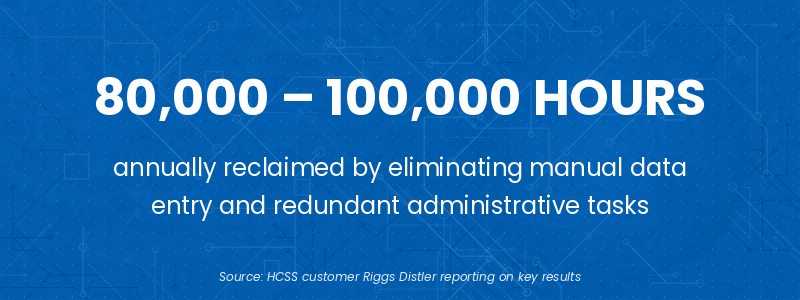
Ask any civil PM how their operational hours are spent, and actual project leadership is rarely the top response. Administrative friction eats into high-value oversight: processing change order documentation, validating quantities against pay items, managing pay applications, and resolving RFIs. These procedural workflows are essential, yet they primarily consist of manual data synthesis rather than strategic decision-making.
Take change order processing. The fieldwork is complete and recognized by the owner, but the supporting data remains fragmented across site notes, inspector emails, spreadsheet line items, and verbal directives. Assembling an audit-ready, owner-approved claim currently demands manual cross-platform reconciliation.
This is where specialized AI creates scalable value. By automatically compiling documentation, aligning field quantities to pay items, drafting cost narratives, and categorizing pending RFIs by responsibility, AI streamlines data consolidation. PMs then apply critical domain expertise: evaluating commercial viability, optimizing pricing models, tailoring client communication, and negotiating terms.
That shifts critical bandwidth back to high-impact leadership activities that drive margin.
Deploying Verifiable AI Architecture
Civil construction teams navigate extensive regulatory and contractual documentation: DOT specifications, special provisions, complex plan sets, and cumulative addenda. Pinpointing a technical requirement across hundreds of pages of project records presents significant latency.
While advanced search algorithms surface critical insights in seconds, unverified outputs introduce project risk. An output without source attribution requires complete re-verification. Conversely, systems providing direct citations to specific drawing sheets or spec sections enable instant auditability while keeping decision-making authority firmly with project leadership. AI without clear provenance should be treated as unverified field hearsay—insufficient for commercial decisions.
Building organizational trust requires starting with structured, low-risk operational workflows, such as compiling automated submittal schedules directly from specs. Benchmarking model performance against source documents establishes clear boundaries of operational reliability. Healthy skepticism aligns with sound risk management. High-stakes field execution decisions should be integrated only after systems prove consistent accuracy within controlled parameters.
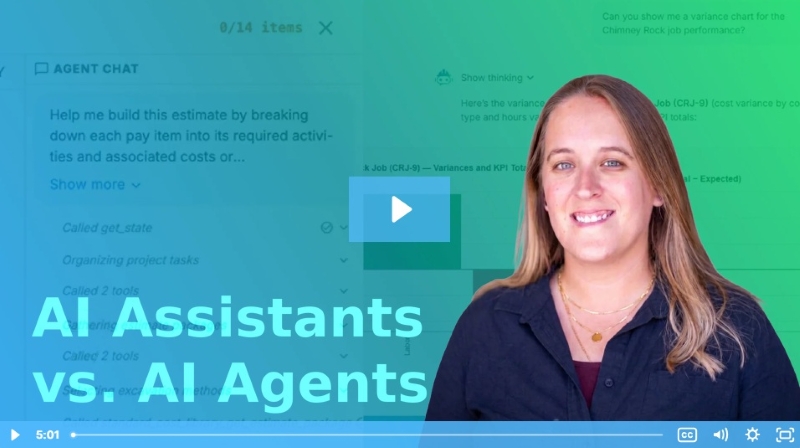
Transparent citations accelerate workforce development. Early-career project engineers who view explicit source references absorb contractual frameworks significantly faster than those who review static summaries. To understand how task-oriented tools evolve into autonomous systems, explore our comparison of AI Assistants vs. AI Agents in Construction in the below video.
Proactive Variance Analysis: Moving from Detection to Diagnosis
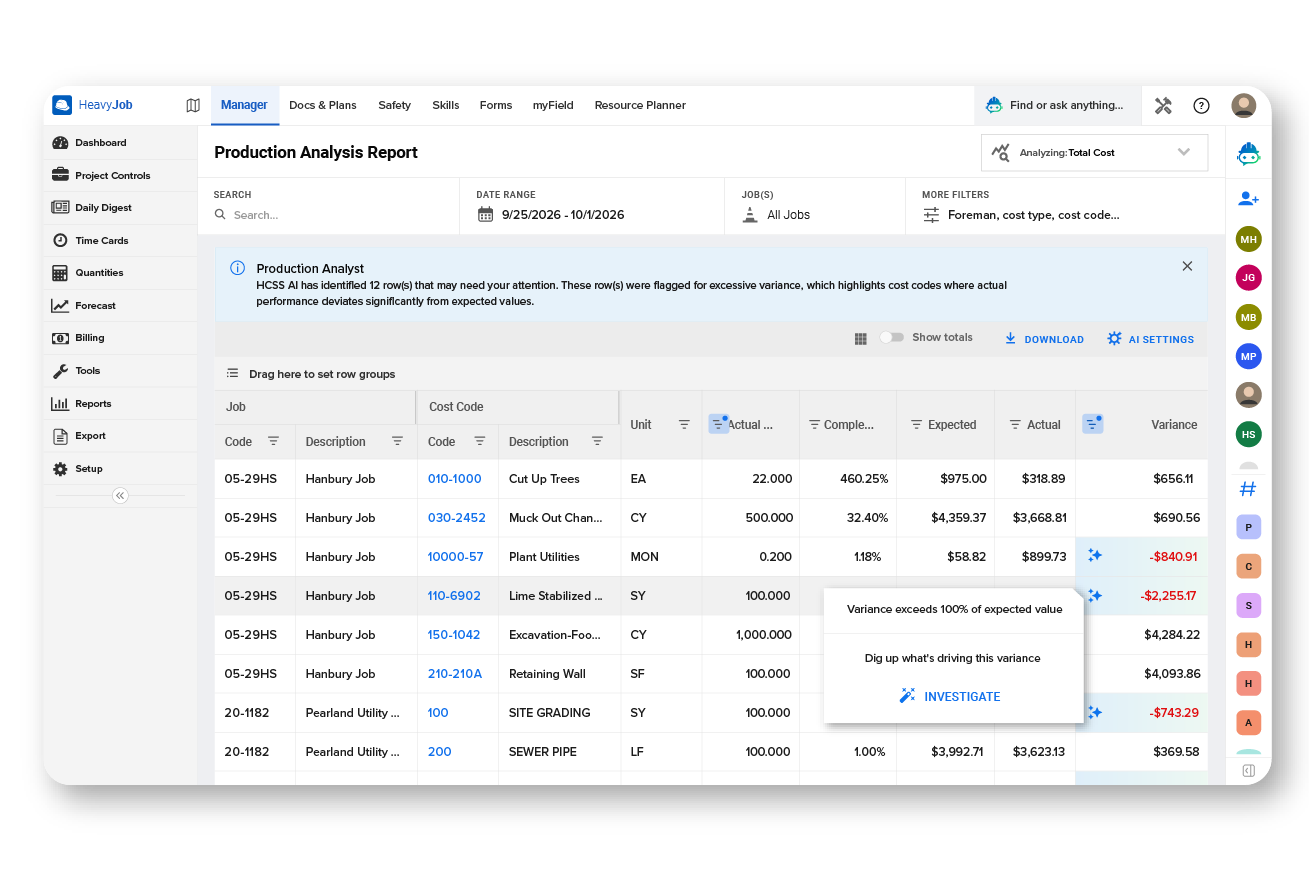
Consider a cost code for earthwork trending over budget. Traditional job cost reporting highlights the variance easily. The operational bottleneck lies in diagnosing the root cause efficiently.
First, leadership must validate the data integrity to rule out misallocated labor hours or incorrect cost coding. Next, teams evaluate contributing drivers: plan quantity growth, sub-optimal equipment production, severe weather impacts, or rework. Isolating these factors typically requires cross-referencing disparate software systems, field logs, and team updates.
Once analyzed, PMs execute corrective strategies: updating EAC forecasts, aligning field supervision, and engaging owners regarding scope adjustments. AI accelerates the diagnostic phase by automatically correlating key operational drivers and underlying documentation, replacing manual investigation with rapid verification. The strategic intervention remains guided by human judgment, taking into account unquantifiable project variables.
Automating variance analysis is a core focus of HCSS engineering initiatives. Production Analyst is built to streamline root-cause analysis so project managers can focus on proactive risk mitigation.
Bridging Field Communications and Enterprise Systems
Project documentation frequently originates in the field, not the office. A superintendent photos a site condition via mobile text, an owner inspector grants verbal authorization, or an RFI resolution sits in an email while jobsite crews wait on direction. Field personnel utilize quick messaging tools because immediate communication drives site operations.
However, informal communication creates institutional risk. Project visibility suffers, critical approvals are missed, and administrative staff spend hours manually transcribing field updates into systems of record—leaving vital decisions trapped in personal chat histories.
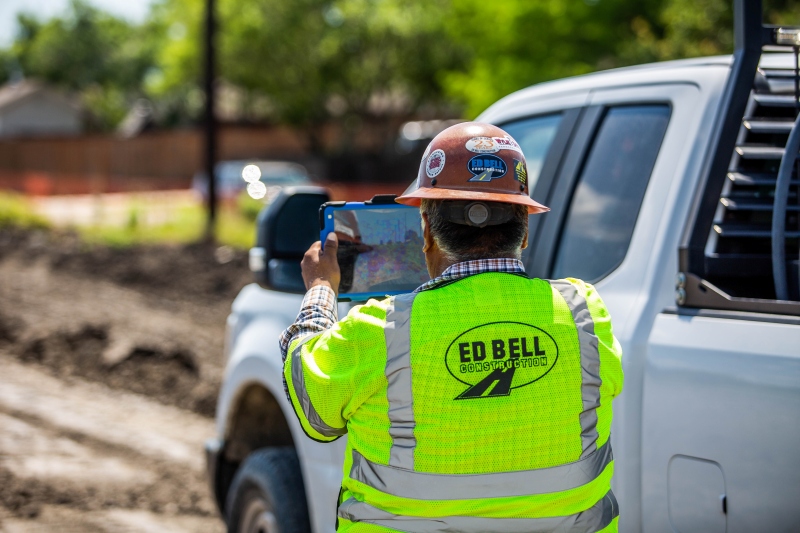
Civil contractors face this operational friction daily. The solution is not burdening field leadership with complex administrative interfaces, but implementing intelligent workflows that capture structured field data directly within existing communications, allowing PMs to validate data rather than re-key it.
Data Standardization: The Strategic Foundation for AI Success
Advanced AI performance relies entirely on underlying data governance. When project teams utilize inconsistent cost structures across jobsites, enterprise-wide benchmarking breaks down. AI lacks institutional memory—it cannot intuitively infer active document revisions, valid pay quantities, or proper cost allocations without structured data standardization.
Establishing strong data hygiene requires clear operational standards: defining uniform work breakdown structures (cost codes, bid items, activities) and validating workflows on pilot projects prior to enterprise rollout. Operational adoption succeeds when field teams experience clear workflow efficiencies.
For deeper strategic insights on data readiness, review AI Is Only as Good as the Data Behind It.
From an IT governance perspective, enterprise-grade, secure software suites mitigate shadow IT risks. HCSS AI strictly enforces role-based access control (RBAC), ensuring proprietary enterprise data remains segregated and fully protected. Additional technical specifications are available on the HCSS Security Portal.

Optimizing Administrative Workflows While Retaining Strategic Control
Seasoned PMs understand the critical variables omitted from construction drawings or contract terms—such as unmapped utility gaps, unforeseen geotechnical conditions, or subtle addenda revisions. Algorithms cannot replace years of hands-on risk mitigation experience; specialized expertise identifies failure modes before they impact the bottom line.
That experience directly informs claim management strategies. Resolving contractual disputes—whether regarding schedule delays, differing site conditions, or disputed quantities—depends on contemporaneous record-keeping. PMs maintaining real-time, structured documentation secure superior commercial positions compared to those compiling retrospective narratives months later. Standardized cost coding and automated field logs form the backbone of sound risk management.
Furthermore, structured historical project data unlocks powerful organizational analytics. Standardized post-job performance data creates a searchable knowledge base, institutionalizing valuable project insights across the enterprise to optimize future estimating and execution.
Ultimately, AI technology is designed to eliminate administrative friction surrounding construction operations, not to replace field management or trade execution. Implementing robust data standards maximizes technology ROI, enabling project managers to reallocate reclaimed time toward driving operational excellence and project profitability.