
When field crews and office staff rely on disconnected systems and paper-based processes for utility project management, earned revenue is often lost. This happens because of unrecorded pay items, late reports, and delayed sign-offs. All of these setbacks make it harder to protect margins across infrastructure projects.
To solve this, modern utility management bridges the gap between the bid and the build. By connecting estimating, field operations, and fleet data, contractors can manage high-volume maintenance and complex sitework, like data center construction, with equal precision. The result is a synchronized field-to-office data flow that protects your margins and keeps projects moving at the speed of the modern grid.
Whether your focus is transmission and distribution, wet utilities, telecom, or renewables, the goal is the same: replacing fragmented processes with a single source of truth. By unifying your workflows, you gain the control and speed necessary to maximize profitability on every job.
Here’s what we’ll cover:
Table of contents
- Identifying the Blind Spots in Utility Workflows
- Why Spreadsheet-Based Workflows Fail Modern Contractors
- Improving Cash Flow and Job Costing With Real-Time Field Data
- Digital Field Reporting: The Key to Faster Invoicing
- Protecting Margins on High-Volume Unit-Price Contracts
- Managing High-Volume Work Orders in Utility Construction
- Eliminating Pay-Item Coding Errors in Bulk Imports
- Connecting Estimating, Field, and Fleet Data in Utility Construction
- A Better Way to Manage Utility Projects
Identifying the Blind Spots in Utility Workflows
Many utility contractors still operate with a patchwork of spreadsheets, paper logs, emailed photos, and manual re-entry between teams. That may feel manageable at first, but it becomes a serious problem once project volume, crew count, or work order complexity start to grow.
This is especially true in utility construction, where work often moves fast. Billing depends on accurate tracking of labor, equipment, quantities, and pay items. In telecom, missing even a small amount of unit-priced work across hundreds of jobs can quietly erase profit. For wet utilities, changing underground conditions can introduce extra work that must be documented immediately to be recoverable. Working wind, solar, and transmission jobs, a single equipment delay can create expensive ripple effects across the project.
Why Spreadsheet-Based Workflows Fail Modern Contractors
Spreadsheet-based workflows break down because they create lag. In many cases, the field finishes the work, but the office does not see the full picture until hours or days later. By then, it may be too late to correct missing production, document a change, or resolve a discrepancy before billing is delayed.
That is why utility project tracking has to go beyond after-the-fact reporting. Contractors need systems that make it easy to capture data where the work happens, standardize workflows, and push accurate information back to the office in real time.
Improving Cash Flow and Job Costing With Real-Time Field Data
The fastest way to improve utility project management is to improve how field data is collected and shared.
To solve this information gap, digital daily field reports help crews document labor, equipment, materials, installed quantities, photos, and electronic signatures directly from the jobsite. Instead of waiting for paper to return to the office, contractors can create same-day visibility into production and progress.
Digital Field Reporting: The Key to Faster Invoicing
How Can Utility Contractors Improve Cash Flow with Digital Reporting
By capturing daily field reports in real time, contractors can reduce delays between completed work and invoicing. When foremen and crews log production and supporting documentation as work happens, office teams can verify pay items faster, prepare invoices sooner, and reduce the risk of unbilled work.
This is especially important in high-volume utility environments where earned revenue is often lost through late reporting, missing documentation, or delayed inspector sign-offs. Faster, cleaner field reporting supports faster cash flow and gives leaders more confidence that the work performed is the work getting billed.
Contractors looking to go deeper on this topic can check out the following guides:
- Maximize Utility Revenue Through Better Field Visibility
- Accelerate Cash Flow with Real-Time Reporting
- Ensure Every Unit of Work Is Fully Billable
Protecting Margins on High-Volume Unit-Price Contracts
What Causes Revenue Loss in Utility Construction Projects?
In many cases, it comes down to incomplete field documentation, missed units, coding errors, and slow reporting. On unit-priced contracts, those small misses add up quickly. If crews install more than they report, or if office teams spend days reconciling paper notes against work orders, contractors lose both time and margin.
Real-time field reporting helps close that gap. It creates a more accurate record of installed work, improves labor productivity tracking, and gives teams a clearer view of real-time job costing before problems compound.

Managing High-Volume Work Orders in Utility Construction
For many utility contractors, the biggest operational challenge is not one large job. It is the avalanche of MSA work orders.
Master Service Agreement (MSA) work often involves hundreds or thousands of small, unit-priced jobs that need to be tracked, coded, updated, and billed accurately. Trying to manage that volume through spreadsheets and paper creates administrative overload and opens the door to expensive mistakes.
What's the Most Efficient Way to Track MSA Work Orders?
The best approach is to use utility work order management tools that support bulk imports, standardized coding, and current rate updates across large batches of work. As an alternative to manually adjusting each work order, contractors can apply changes at scale and keep teams aligned with the latest pricing structure.
That reduces pay-item coding errors, speeds up workflows, and improves consistency across the entire operation. It also makes utility construction workflows more repeatable, which matters when teams are juggling quick-turn work alongside larger infrastructure projects.
Eliminating Pay-Item Coding Errors in Bulk Imports
How Do Utility Contractors Manage Thousands of Work Orders?
They standardize the process. Modern systems help contractors import, organize, and update work orders in bulk while preserving the structure needed for clean billing and cost tracking. This is critical in utility project management because even minor coding mistakes can create billing disputes, lost revenue, and unnecessary office rework.
For contractors trying to scale MSA work without scaling administrative chaos, this is one of the biggest opportunities to improve efficiency.
Connecting Estimating, Field, and Fleet Data in Utility Construction
The strongest utility contractors are not just digitizing forms. They are building connected operations.
Unfortunately, three prominent areas—estimating, field, and fleet—often live in separate systems, causing teams to lose visibility. Estimators cannot easily compare bid assumptions to actual production. At the same time, operations leaders often see labor performance too late. Even equipment costs and downtime stay isolated from the rest of the job story.
However, when those systems are connected, contractors gain a much clearer picture of utility performance across infrastructure projects.
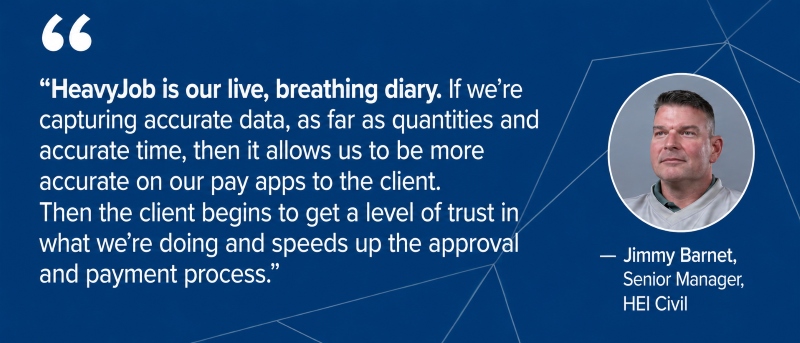
HeavyBid supports standardized estimating and reusable templates for repeatable utility work. HeavyJob helps record field production, daily quantities, labor hours, and jobsite documentation in real time. HCSS Fleet adds visibility into equipment usage, utilization, and preventive maintenance for specialized assets such as trenchers, directional drills, and cranes.
Together, that creates a more complete operating model for construction cost control. Leaders can track labor hours, production rates, and fleet utilization with more confidence and respond while the work is still underway.

What Are the Benefits of Integrating Estimating and Field Operations in Utility Projects?
Integrating systems on a single platform reduces handoff friction, improves project visibility, and makes job cost data more useful in utility project management. Rather than compare disconnected reports from different teams, contractors can align estimate assumptions with field reality and see how work is performing as it happens.
That leads to better construction cost control, fewer surprises at closeout, and stronger decision-making across the business.
Which Tools Do Utility Contractors Use to Collect Real-Time Data?
They use digital field tools that allow crews to enter Daily Field Reports from the jobsite, including labor, equipment, quantities, photos, notes, and electronic signatures. The goal is to eliminate delays, reduce manual re-entry, and create a reliable field-to-office data flow that supports billing, payroll, compliance, and project tracking.

Why Is Real-Time Job Costing Critical for Utility Margins?
Job costs are easiest to track when field production, labor hours, and equipment usage are tied back to the estimate in real time. Instead of waiting until the end of the week or month, contractors can monitor performance daily, spot trends earlier, and take corrective action before margins slip.
A Better Way to Manage Utility Projects
Utility project management works best when it connects the field, office, and fleet rather than leaving each team to manage its own version of the truth.
For utility contractors using HCSS, this goes way beyond just replacing paper. It means building workflows that capture billable work, simplify MSA work order management, improve utility project tracking, and support real-time job costing across every phase of the project.
The contractors who do this well are better positioned to protect margins, speed up cash flow, and scale operations without adding unnecessary manual burden.