
Every software vendor has an AI story right now. Most of them are the same story: a chatbot bolted on top of existing products, generating answers that sound plausible but aren't grounded in your business.
HCSS takes a different approach. Because the difference isn't the AI, it's what's underneath it.
The honest truth about AI in construction
Data is often referred to as "the new oil," but oil, when unrefined, cannot be used. Likewise, AI is only as useful as the data that feeds it. That's true in every industry, but in civil and infrastructure construction, it's especially consequential because the data has historically been fragmented, inconsistent, and siloed across systems that don't communicate with each other.
Without structured, connected, and reliable data, AI has very little to work with. Feed it outdated or disconnected spreadsheets and mismatched records, and it produces generic, untrustworthy output. But when the data is granular, structured, and connected across your entire operation, AI becomes genuinely powerful. Not as a novelty, but as a system that amplifies what your teams are already doing.
That's the principle behind everything HCSS has built over the years. Before we could build AI worth using, we had to build the data foundation it would run on. A real-world example comes from McGuire & Hester, which is building an AI-ready data foundation before scaling agentic AI across its business.
Why our data is different
There's a second piece to this that doesn't get talked about enough. HCSS’s AI is unique because our data is unique, and our data is unique because our proximity to our customers is unmatched in this industry.
We know what matters to them because we're in the rooms where the big decisions get made and where safety, infrastructure, and the local communities are on the line. That's not a marketing claim. It's how HCSS has operated for 40 years, and it's the reason the data flowing through our platform reflects how heavy civil work actually gets done, not how a horizontal SaaS vendor thinks it gets done.
You can't shortcut that. A general-purpose AI doesn't know what a balanced bid looks like, what a realistic production rate is for a specific crew on a specific job, or why a certain cost code matters more than the others on a DOT project. We do, because our customers have been teaching us for four decades.

What "connected data" actually means for a contractor
When estimating, field operations, and fleet performance operate in separate systems, everyone is working from an incomplete picture. Project managers are reconciling job costs against estimates that were built in a different tool. Equipment decisions are made without visibility into how utilization is affecting job performance. Safety events get logged but never connected to the broader pattern.
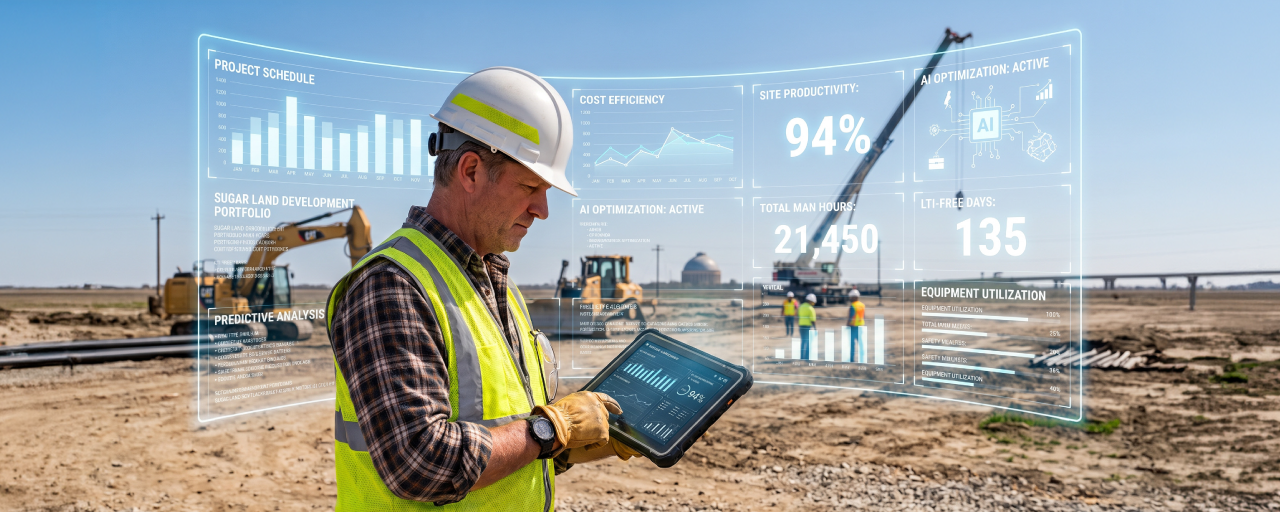
When those systems are unified, something different becomes possible: a 360-degree view of the business, in one place, in real time. Not a report you pull at month-end. A living picture of how your jobs are running.
HCSS has invested heavily in building that unified foundation. HeavyBid, HeavyJob, and HCSS Fleet have been consolidated into connected data models, so information flows across the platform rather than sitting in separate silos. The HCSS Marketplace now supports more than 60 integrations, including Samsara, Geotab, and Clearstory, keeping the data feeding into HCSS current and accurate without manual effort. HeavyBid has moved to the web, creating the infrastructure needed for AI-assisted estimating in the years ahead.
All of the work around the HCSS platform is what enables the success of each HCSS product.
What AI can do when the foundation is right
With that connected operational model in place, the HCSS platform can do things that a general-purpose AI assistant simply cannot. It's not working from training data scraped from the internet. It's working from your data, your jobs, your crews, your bids, your equipment, and it's able to surface insights that actually move the needle.
HCSS treats customer data as a strategic asset, not a byproduct of business. So when that connected, operational model is applied, you can move beyond surface-level metrics & find the insights that are actually relevant to your business.
In practice, that means using AI across construction workflows in ways that improve access to data, speed up analysis, and help teams make better decisions. It looks like this:
- Simplifying access to data. Ask "which jobs were over budget last week?" and get the answer directly from HeavyJob in plain English, without requiring you to navigate dashboards or run reports. Ask it to chart the variance across active jobs, and it builds that view on the fly.
- Taking on complex, time-consuming tasks. Reviewing thousands of lines of an audit trail in HeavyBid used to take hours. AI-powered audit summaries condense the entire log into a clear narrative with one click, so lead estimators and executives can see how a bid evolved without scrolling through line after line. Daily Digest summaries in HeavyJob roll several days of field data into a quick narrative your team can read in under a minute.
- Getting you where you need to go, fast. Page search lets you jump directly to any page or feature across the HCSS products you have access to. Type what you're looking for and go — no clicking through menus to find the screen you need.
- Helping your teams make better decisions, faster. The goal isn't to replace the judgment of your project managers and estimators. It's to give them better information, faster, so they can act with greater confidence. No analyst required. No multiple systems to cross-reference.
The AI questions to ask any vendor
When you're evaluating an AI claim from any piece of software, the question isn't whether or not they use AI. Everyone has AI now. The question is what data does the AI use to make decisions or surface insights? Is it connected across your entire operation? Is it detailed enough to answer the questions that actually matter?
For HCSS customers, the answer is yes, because building that foundation was the prerequisite, not an afterthought.
How HCSS is putting AI to work for your team
We’re investing across the HCSS agentic platform to take more work off your team’s plate. A few of the areas you can expect to see progress:
- Smarter estimating: AI that helps your team get to a better first draft, faster.
- Informed decisions on cost and performance: Make sense of why a job is trending the way it is, so your team can act on it, not just see it.
- Less paperwork in the field: Improved field entry, so the parts of the day that don’t need a keyboard don’t require one.
- Better reporting and data analysis: More ways to ask questions of your data and get useful answers back.
- More integrations: Connect HCSS to more of the tools you already use to run your business.
The contractors who win the next decade won't be the ones who adopted AI first. They'll be the ones who build the right digital foundation first, then let AI do what it's actually capable of on top of it. We've been at this for 40 years. The platform we've built underneath reflects that.
The AI is the visible part; the data foundation that powers it, and the proximity to our customers who shape it are what make it work.