Rapid growth often exposes limitations in existing processes, creating the need for greater visibility and consistency across labor, production, equipment, and project performance.
Issue: Scaling Consistently Across a Growing Organization
As Riggs Distler expanded nearly fivefold over a decade, operational processes developed organically within individual business units. While teams continued to deliver high-quality work, core data- labor hours, equipment usage, production quantities, and daily reporting- was captured in different ways across projects and regions.
Information lived in spreadsheets, emails, photos, and field notes. Estimating approaches varied by group. Leadership could see outcomes, but real-time visibility into production trends, job costs, and margin risk often lagged behind field activity.
The company’s challenge wasn’t execution; it was aligning processes and data as the organization scaled.
Solution: A Field-First, Outcome-Driven Technology Strategy
Riggs Distler assembled a small, cross-functional technology team focused on business outcomes, not just software deployment. The goal was to create a consistent operational foundation across estimating, field execution, and fleet management without disrupting how crews actually worked.
The company selected HCSS as its core construction technology platform, deploying:
- HeavyJob for field timekeeping, production tracking, and daily reporting
- HeavyBid for standardized, data-driven estimating
- Equipment360 for integrated fleet and maintenance management
Rather than a top-down rollout, the team followed a crawl-walk-run approach, partnering closely with field leadership, iterating configurations, and refining workflows based on real-world use. Data quality and usability were prioritized from day one.
“Technology only works if it supports the business,” said Jason McKay, Chief Information Officer. “If you layer software on top of a bad process, it just makes failure happen faster. We focused on getting the process right first.”
Outcome: Visibility, Standardization, and Time Back to the Field
Today, Riggs Distler operates on a unified platform that delivers consistent data across business units while still allowing flexibility for different types of work.
Key results include:
- An estimated 80,000 – 100,000 hours annually reclaimed by eliminating manual data entry and redundant administrative tasks
- Real-time visibility into labor, production, equipment usage, and job costs
- Earlier identification of margin risk and performance trends
- Strong field adoption driven by practical workflows and ease of use
Importantly, the time savings were not achieved through workforce reductions.
“This wasn’t about cutting headcount,” McKay explained. “It was about giving time back to our crews so they can focus more on safety, training, customer relationships, and doing the work right.”
“Before, every team had their own way of tracking information. HeavyJob gave us a single source of information that’s easy to use and actually reflects what’s happening in the field.”
- Andrew Spurr, Project Manager / Business Analyst
Scaling with Intent During Rapid Growth
Riggs Distler’s growth over the past decade has been both significant and strategic. As the company expanded nearly fivefold across power generation and utility infrastructure markets, leadership recognized that sustaining consistent execution at scale would require stronger alignment across teams, data, and processes.
With nearly a dozen business units operating across diverse markets and geographies, project teams had developed workflows tailored to their specific needs. While effective locally, this decentralized approach made it difficult to maintain standardized reporting and real-time visibility across the enterprise, particularly as project volume increased.
“We had a lot of smart people using the tools they knew would get the job done,” recalls Project Manager/Business Analyst Andrew Spurr. “Spreadsheets, emails, photos- everything worked, but it lived in too many places.”
As a result, labor tracking, equipment usage, quantities, and daily reporting existed across multiple systems and formats. Leadership could still manage performance, but identifying trends or emerging risks, such as early margin pressure, often required looking backward instead of acting in real time.
When Chief Information Officer Jason McKay joined Riggs Distler a decade ago, he saw an opportunity to build a more connected construction technology foundation, one designed to support the company’s trajectory, not overhaul how teams worked.
“We viewed HCSS as a way to create a single ecosystem that reduced complexity and brought consistency to our data,” McKay explains. “Advanced reporting, BI, and AI don’t matter unless the underlying data is solid. That’s always been our focus- get the data right first.”
A Business-Led Approach to Digital Transformation
Rather than forcing change from the top down, Riggs Distler took a deliberate, field-first approach. A small, dedicated technology team was formed to work closely with operations, aligning every technology decision to business outcomes: revenue protection, cost control, and long-term scalability.
“We don’t think in terms of IT projects,” McKay says. “There are business projects that have technology components. We focus on the business process that is aligned to business strategy, define the problem to solve, and then layer on the technology that aligns to the solution.”
This philosophy shaped Riggs Distler’s digital transformation, ensuring software enhanced real-world workflows instead of disrupting them, an especially critical consideration in construction, where downtime in the field has immediate financial and operational consequences.
With that mindset, the team focused on driving adoption where it mattered most: production tracking and timekeeping in the field. When McKay was asked to present on HeavyJob, he did away with boring PowerPoint slides, and deferred to an actual foreman using HeavyJob
When executives questioned whether the foreman was in the office, the foreman turned on his camera, live from the field, as he worked in an excavator. The foreman then walked leadership through real-time production tracking for construction, directly from the jobsite.
“I could not have scripted that any better if I tried,” McKay laughs. By consolidating utility construction operations into a single platform, Riggs Distler eliminated redundant paperwork and inconsistent reporting. In short, having HCSS in their corner standardized construction workflows and unlocked massive efficiency.
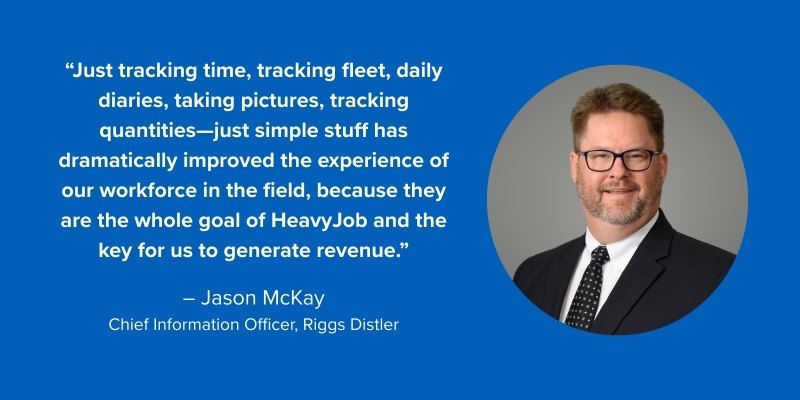
“Even using conservative estimates, we’re giving back between 80,000 and 100,000 hours each year,” McKay says. “That’s not about cutting headcount. It’s about allowing our teams to spend more time on safety, training, customer relationships, and proactive decision-making instead of administrative tasks.”
While adoption took time, as it does with any meaningful change, the value became clear quickly. Spurr recalls one group that briefly reverted to spreadsheets after implementing HeavyJob.
“They didn’t last long,” he says. “A few months later, they were the first ones asking to get back on it. Once you’ve experienced that level of visibility, you don’t want to go backwards.”
Unifying a workforce of this size across hundreds of active jobsites is no small task. Riggs Distler approached it with discipline, focusing on simplification and consistency rather than over-engineering.
“I truly see HCSS as a business partner,” McKay says about the HCSS platform. “It’s one ecosystem. From a technology perspective, I try to reduce the complexity and variation as much as possible. It’s like the plumbing of a house. The more complex it is when something goes wrong, it’s harder to find a root cause, and it could be harder to fix it.”
The Software-Driven Shift that Transformed Riggs Distler’s Operations
To support consistent execution across the organization, Riggs Distler implemented the following software platforms.
- Operations/Project Management Software (HeavyJob): Used for tracking time, fleet, daily diaries, and quantities. It provides a “standard baseline” across 11 different business units.
- Estimating Software (HeavyBid): Delivers consistent bid comparisons using historical production data and standardized assemblies, while providing data-driven insight into why bids are won or lost.
- Fleet Management Software (Equipment360): Integrates maintenance work orders, mechanic timecards, and equipment history in one system- improving visibility and uptime.
Now that its utility operations are positioned to scale with confidence, the company harnesses clean, structured data and unified processes as its foundation across all its business units. This transformation supports continued expansion across utility, industrial, and government markets, all with HCSS as a trusted long-term partner.
A Checklist of Advice for Contractors Looking to Scale Efficiently
Working for a rapidly growing company is an excellent problem to have. Here is a quick checklist of highlights from Riggs Distler containing a few practical lessons to help scale as effectively as possible.
-
- Place process before technology: Software should reinforce good processes, not compensate for weak ones
- Choose a partner, not a vendor: McKay values HCSS because they listen to feedback and have a “three-ring” support policy.
- Standardization is key: Even with diverse business units, a common platform creates clarity without limiting how teams work
Want to see firsthand how HeavyJob and other HCSS solutions free up time, remove stress, and unlock cash flow? Request a quick demo, and a software expert is ready to help.