

Work in progress (WIP) accounting is the method construction companies use to track costs, billings, and earned revenue on a contract while the dirt is still moving. These reports track all the work completed and important milestones throughout the job. That process then rolls into the WIP schedule, which shows how much work is actually complete, how much has been spent, and how much has been billed for every job across your backlog.
A WIP report typically answers four core questions:
- How much have we spent on this job so far?
- How much have we billed the customer
- How much of the work is actually complete?
- Are we ahead of or behind our budget and billings?
That said, anybody in heavy civil can tell you, “WIP can get complicated fast.” A highway widening or bridge rehab can stretch across 18 months and three fiscal years. DOTs and municipalities follow fixed pay-estimate cycles. And many contracts are priced by the unit, whether that is a ton of asphalt, a cubic yard of excavation, or a linear foot of pipe. (Nothing is ever laid out perfectly.)
A WIP report (often called a WIP Schedule) connects the financial side of a job to what’s actually happening in the field. It brings costs, billings, earned revenue, and project progress into one clear view. In this article, we’ll break down what goes into a WIP report, how contractors use it, and why accurate WIP accounting is absolutely crucial to protecting cash flow, catching profit leaks, and keeping projects financially on track.
What are the key components of a WIP Report?
A WIP report breaks down every active job, then compiles them all into one clear view of your entire backlog. This makes it easier to see which jobs are on track, which ones are slipping, and (more importantly) where margins may be taking a hit.
Each row gives you a snapshot of a job’s financial health and typically includes:
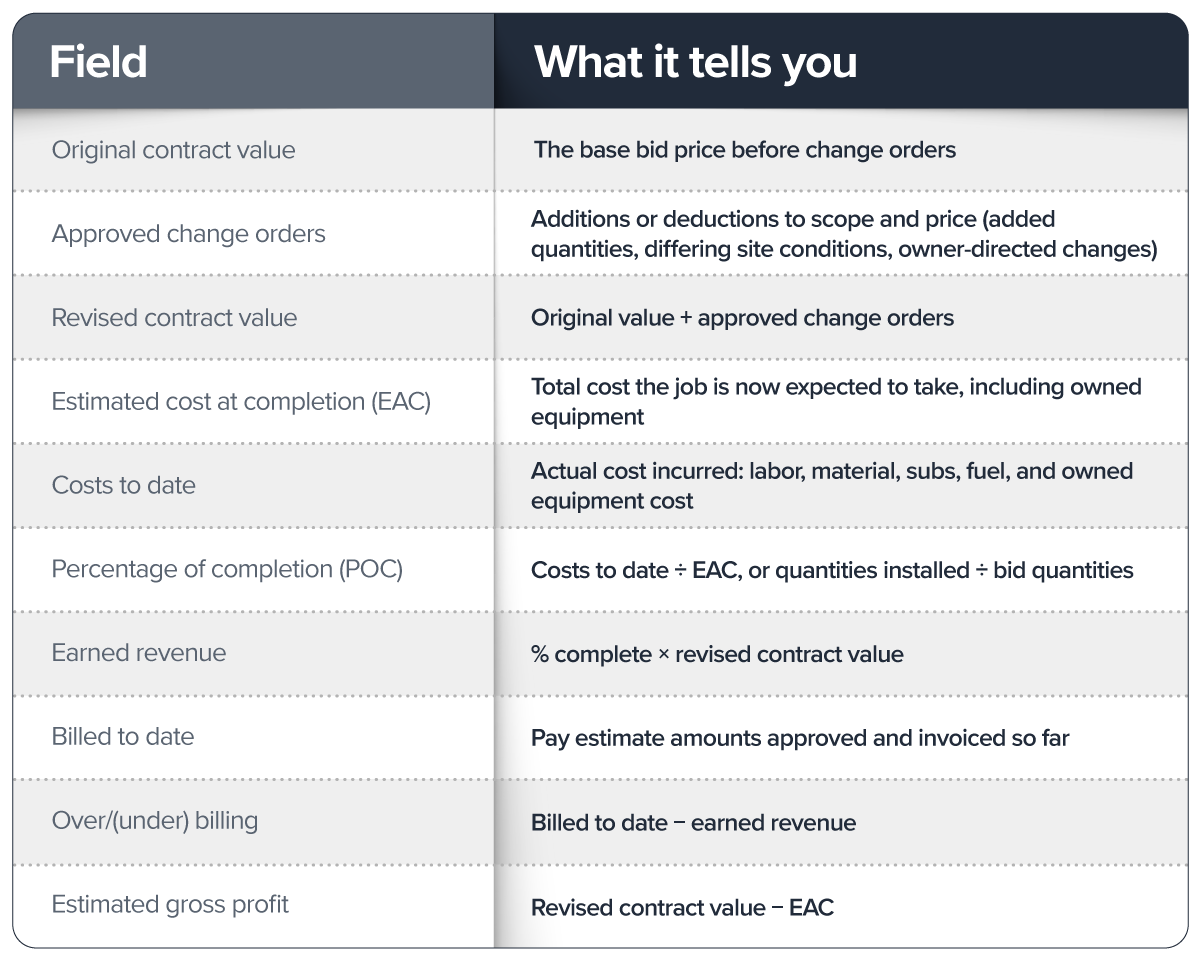
Yes, there is plenty of information to look at, but the two rows that do most of the heavy lifting are percentage complete and over/underbilling. On a heavy civil job, the percentage of completion (POC) can be calculated three different ways — and which one you use changes everything down the line.
How to Calculate Percentage of Completion (POC)
If you get the percentage-of-completion method wrong, your revenue numbers can quickly take a nosedive. Contractors using POC in their WIP reporting need to ensure their calculations and revenue recognition practices comply with Financial Accounting Standards Board (FASB) standards and guidelines.
That means accurately tracking job costs, calculating how much work is truly complete, and recognizing revenue at the right time. If those numbers do not follow FASB standards, contractors risk inaccurate financial reports, compliance issues, and a misleading view of job profitability.
The three most commonly used methods to get this done are cost-to-cost, hours of output, or units of output.
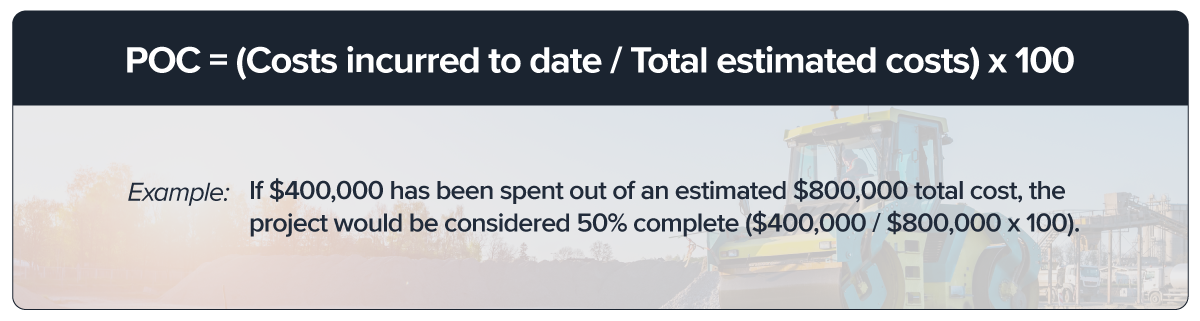
Method 1: Cost-to-cost
The cost-to-cost approach measures progress by comparing what you have spent so far to the total estimated cost of the job. It is one of the most common methods because, when your cost data is accurate, spending is often a strong indicator of how much work is actually complete.
To consider: It requires accurate cost tracking and regular updates to estimates to ensure precision. For example, if you front-load large material purchases, you’ll artificially spike your completion percentage early on.
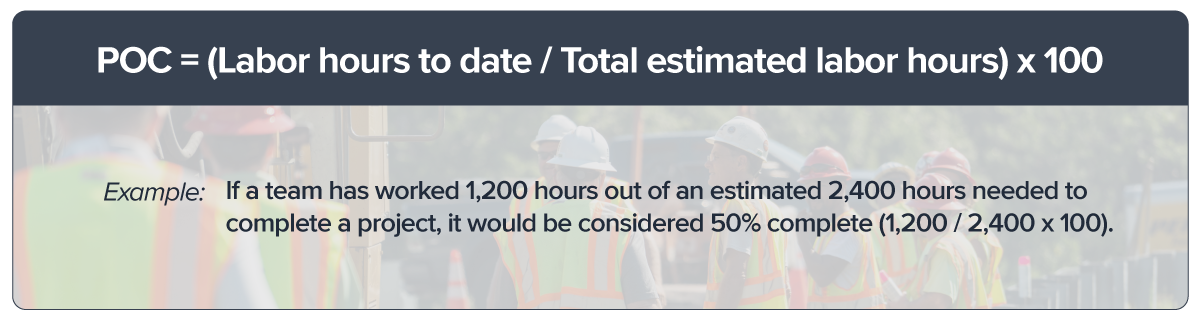
Method 2: Hours of output
The hours-of-output method measures progress by comparing labor or equipment hours used so far against the total hours estimated for the job. It works well when time and effort closely reflect the work completed.
To consider: Requires accurate time-tracking logs, and you might not get the full story if costs fluctuate or projects get delayed.
Method 3: Units of output
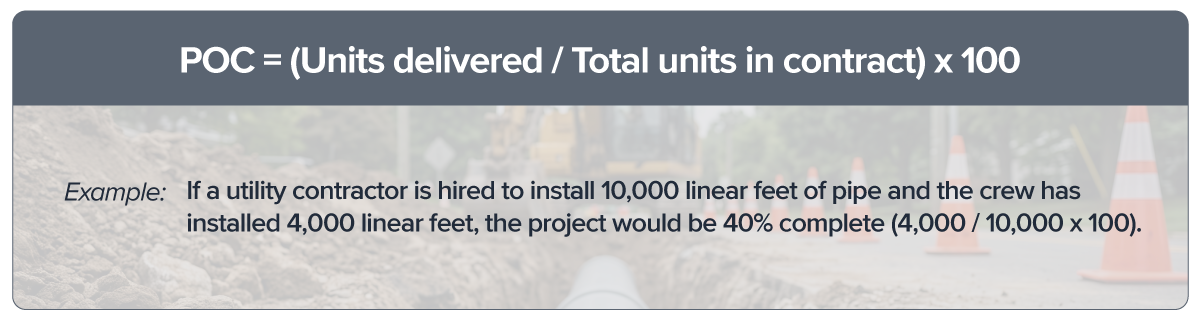
The units-of-output method measures your progress by comparing the number of completed units against the total units expected for the job.
To consider: Works beautifully when each deliverable is consistent and easy to track. However, if not every unit requires the same amount of work or costs the same to complete, your numbers might not be accurate.
Overbilling vs. Underbilling
Billings and earned revenue rarely match exactly, and that gap is normal on a heavy civil job — the only question is: Which direction is it running? And is it getting worse over time?
Ignoring overbilling and underbilling can give you a false picture of a job’s financial health. The best way to avoid this oversight is to spot and correct these gaps early, so that billings stay aligned with earned revenue, and you have numbers you can trust.
- Overbilling happens when you invoice for labor and materials outlined in the contract before the work has been fully completed. While on paper this can positively impact your cash flow, it could also mean that work is being churned out more slowly than expected.
- Underbilling means work is ahead of billing. This happens when you bill less than the amount earned for the work completed to date. Typically happens for a variety of reasons, including project scope changes, delays, or discrepancies between progress and billing.
How to Read and Act on a WIP Report
Your accountant emails you this month’s construction WIP report. You see columns of numbers, data strung together, and an overwhelming amount of dollar signs (hoping they’re positive). Don’t fret, here’s how you can tackle a WIP, so your financials stay healthy, and your lenders stay trusting:
1. Check the estimate first. Your percentage of completion (POC) is only as reliable as your estimated cost at completion or bid quantities. If EAC hasn't been updated since the latest change order, every number after…is already off.
2. Compare it to the pay estimate. On unit-priced work, for example, your internal percentage complete should stay close to the quantities approved by the owner. If that gap keeps widening, a quantity dispute might be coming.
3. Follow the trend, forget the snapshot. Never put all your weight on one number. A $40,000 underbilling gap on a $9 million interchange may be no big deal. On a $400,000 culvert job, it is nearly 10% of the contract. Look at the gap as a percentage of contract value, then check whether it holds steady or grows with each pay cycle.
4. Catch margin fade early. If the estimated gross profit is shrinking period over period without a scope change, that's usually a production rate or equipment cost problem in the field, not an accounting one. This is much easier to fix mid-job than at closeout…if you catch it early.
5. Check in with the superintendent. The numbers on the WIP schedule should match what the field believes is actually in the ground. A gap between the two is usually the earliest sign of a problem.
6. Stick to a schedule. Run your WIP monthly and tie it to the pay estimate cycle. Waiting for quarter-end or year-end defeats the purpose of a real-time report.

5 Common Mistakes in WIP Accounting
1. Failure to update estimates.
Without automated real-time data, you’re responsible for updating your cost estimates. If the original estimates for a project are not updated to reflect changes in scope, costs, or schedules, your WIP report will not paint a true picture of your project’s financial status.
2. Recording laggy field costs.
If time cards, fuel tickets, and equipment hours take two or three weeks to reach the accounting system, every WIP report reflects a project as it existed weeks ago…not as it exists today.
3. Neglecting overbilling or underbilling.
Seems like a no-brainer, but over- or underbilling is a great way to blur your financial picture. To maintain financial accuracy and integrity, it’s important to keep them at the top of your priority list.
4. Not reconciling the WIP schedule to the ledger.
Yes, a single late journal entry or a cost coded to the wrong job can throw the WIP schedule and job cost ledger out of whack. Check that they tie out every closing cycle, especially before the report goes to a bank or surety. Even a small mismatch can make them question the rest of the numbers.
5. Lacking detailed notes on the WIP report.
The devil’s in the details. A WIP report without clear notes invites mistakes and inaccuracies. Document all assumptions, progress calculations, scope changes, and accounting adjustments behind each number to get a complete report.
Why WIP Accuracy Depends on Field Data
Whether it’s the field costing or the estimates, every WIP mistake ties back to the same root cause: Your field data and important information are not reaching your accounting system.
You might not be thinking about field data from that lens, but time cards, haul counts, asphalt tickets, production quantities, and equipment hours all affect WIP schedules before they ever become a line item in accounting.
That's why the heavy civil contractors with the most efficient WIP reporting tend to be the ones who've shortened the distance between the field and the office. Instead of batching, re-entering, and cleaning up spreadsheets, top firms capture their data at the crew level and flow directly into the accounting system. This gives the CFO and the surety the numbers they can trust without having to dig through the files.