
For construction contractors, think of your safety performance as a commercial credit score, with Total Recordable Incident Rate (TRIR) being the ultimate pass/fail metric for winning new business. In an industry where stakeholders demand transparency, this number determines whether you’re considered or disqualified before the bid even begins. Maintaining a premier rating is now a foundational requirement of credibility rather than just another way to stay compliant.
What is TRIR, and Why is it the Construction Industry’s Safety Credit Score?
TRIR stands for Total Recordable Incident Rate. It’s OSHA’s standard for measuring the number of recordable injuries and illnesses per 100 full-time workers over a year. The goal is to create a common yardstick so companies of different sizes can be compared more fairly.
TRIR gives owners and clients a simple number to assess risk. It doesn’t tell the whole story of a company’s safety culture, but it’s often one of the first safety numbers people look at. OSHA itself notes that injury and illness data can help outside parties make informed decisions, while also cautioning that you should not judge an establishment solely by those rates.

How to Calculate TRIR
The formula is standardized so that a firm with 500 employees can be compared fairly against a firm with 50. The 200,000 figure represents the number of hours 100 employees would work in a year, based on 40 hours per week for 50 weeks.
| The OSHA-standard formula is: | ||
|---|---|---|
| TRIR | = | Number of Recordable Injuries × 200,000 Total Number of Hours Worked |
The formula itself is straightforward. The hard part is keeping the number low in a business where a single event can quickly change the picture.
Why TRIR Matters in Construction
If Experience Modification Rate (EMR) affects what you pay for insurance, TRIR often affects whether you make it through prequalification.
Many utility, industrial, and public-sector projects evaluate contractors through safety prequalification processes. In those situations, a low TRIR can strengthen your position by signaling consistent safety performance. A higher TRIR can create friction, extra scrutiny, or even disqualification depending on the owner, the project, and the threshold being used.
What Is the Average TRIR for Construction?
This is one of the most common questions when it comes to TRIR.
According to the U.S. Bureau of Labor Statistics, the 2024 total recordable case incidence rate for construction was 2.2. For heavy and civil engineering construction, it was 1.8. For utility system construction, it was 1.4. What makes this context so important is that utility contractors may be judged against a lower segment-specific benchmark than the overall construction average.
So, what is a good TRIR in construction?
A TRIR around or below your segment average is generally a healthier signal than one that materially exceeds it. A rate near 1.0 is often viewed as strong performance, but the real comparison point is your specific market, your work type, and what your clients expect in prequalification.
The Cliff Effect: Why One Incident Can Change Everything
TRIR can be unforgiving, especially for small to mid-sized contractors.
Because the formula is tied to total hours worked, just one recordable injury can cause a major spike if your company logged fewer hours that year. That’s what the cliff effect is. That one event can move your rate enough to change how your company looks on paper, even if the business is otherwise well run.
Unfortunately, that’s also how leaders sometimes get into trouble. When pressure is high, some organizations start treating recordables as a reporting problem rather than a prevention problem. Under-reporting does not make a jobsite safer, but it does make the data less honest.
Looking for more safety insights first? Download our safety eBook for additional guidance on building a more proactive safety program.
TRIR vs. EMR vs. DART Rate
Contractors often use these terms together, but they measure different things.
TRIR measures the frequency of OSHA-recordable incidents over a single year. It’s often reviewed by clients, owners, and safety prequalification platforms.
EMR, or Experience Modification Rate, looks at the cost and severity of workers’ compensation claims over a rolling multi-year period and is most closely tied to insurance.
Days Away, Restricted, or Transferred (DART) rate measures cases involving days away, restricted duty, or job transfer. It’s another OSHA/BLS safety metric that project owners may review when evaluating contractor risk. BLS publishes DART alongside total recordable case rates in its industry tables.
A simple way to think about it is this:
- TRIR asks: How often are recordable incidents happening?
- EMR asks: How costly and severe have claims been?
- DART asks: How often are incidents serious enough to affect someone’s ability to do their normal work?
In other words, a strong contractor builds a system that improves the full safety picture.
TRIR Is a Lagging Indicator. Leading Indicators Are How You Lower It.
TRIR tells you what already happened, making it a lagging indicator.
If you want to lower your TRIR, you need to track things that help prevent recordables before they happen. Those leading indicators can include near-miss reporting, daily JHAs, field observations, corrective actions, and other forms of real-time safety documentation.
Here is where digital safety documentation becomes valuable. Paper forms and binders may check a box, but they often make it harder to see patterns, close the loop on issues, and create consistency. Real-time safety data gives teams a better chance to spot risk early and respond before a near miss becomes a recordable incident.
Construction Safety Week: Recognize, Respond, Respect
This year’s Construction Safety Week theme makes that idea even clearer.
Construction Safety Week is centered on the Recognize, Respond, Respect framework for high-energy, high-hazard work and the prevention of serious injuries and fatalities. The campaign also emphasizes STCKY, or Stuff That Can Kill You, to help crews identify the hazards most likely to result in severe outcomes.
That makes Safety Week a strong reset point for contractors to:
- Recognize the high-energy hazards and SIF precursors on your jobsites.
- Respond with better planning, communication, and controls.
- Respect the reality that one missed hazard can change a worker’s life and a company’s trajectory.
When teams understand that connection, TRIR stops being just a year-end score and becomes the output of a daily safety culture.
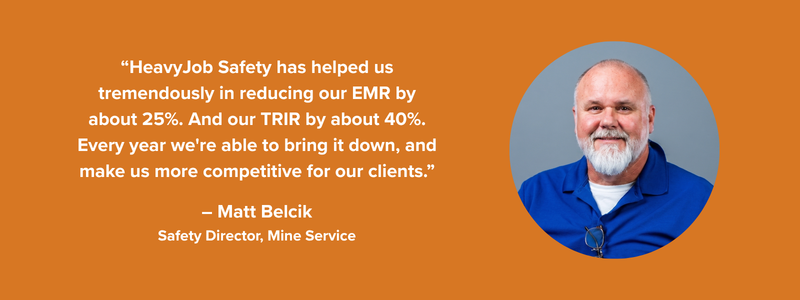
Turn Your Safety Record Into a Competitive Edge
Now more than ever, you cannot hide a poor safety record. Between OSHA’s public data initiatives and third-party pre-qualification platforms, your TRIR is your brand. Protect it by protecting your people.