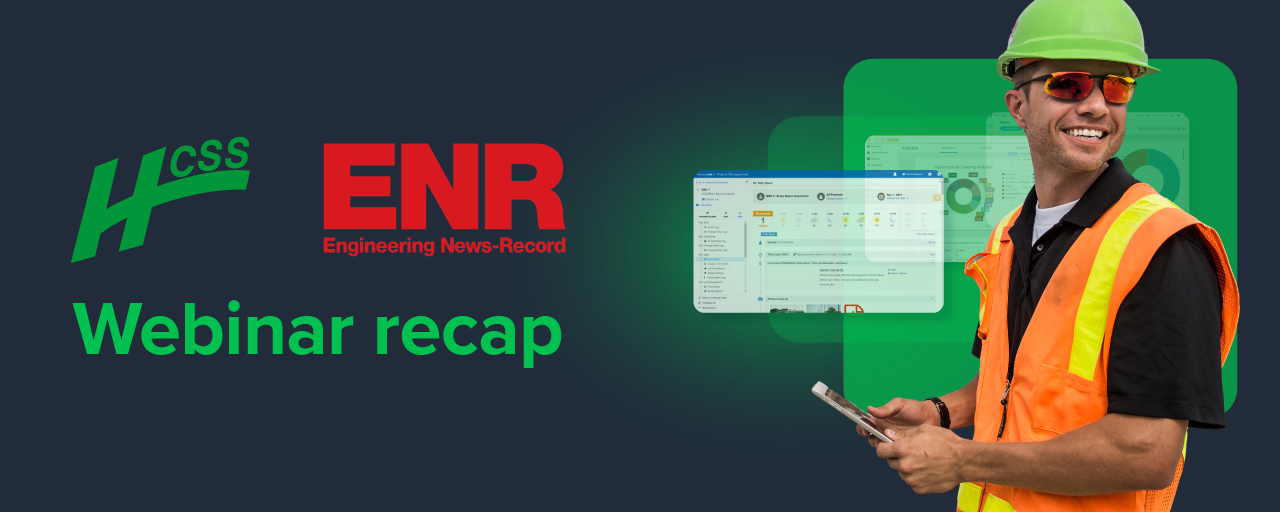
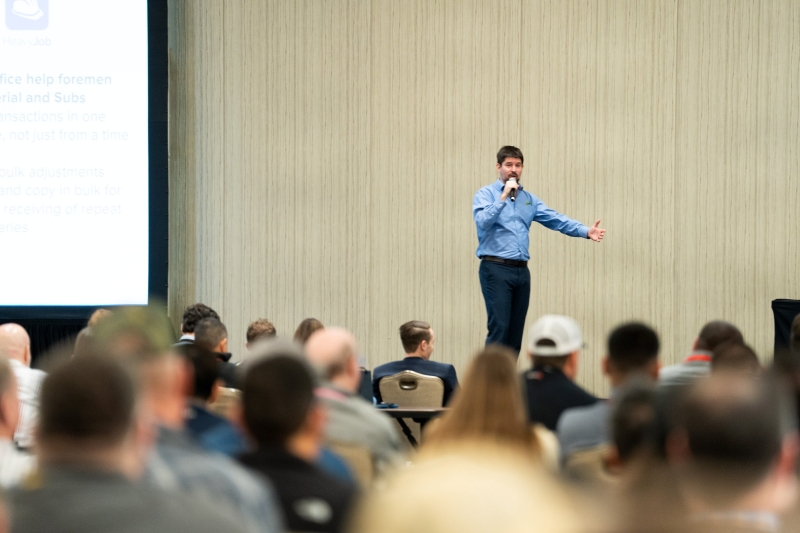
Infrastructure and utility contractors face unique challenges, including juggling thousands of work orders, trying to pin down accurate and timely billing, and the pressure to keep crews productive across all these distributed projects. In a recent webinar hosted by Engineering News-Record (ENR), HCSS product leaders Stuart Falknor and Frank Baumgartner joined to discuss how leading contractors are tackling these challenges by using technology that connects the field and office.
A few of the strategies covered (and expanded on below) included:
- Operational trends shaping today’s utility contractors
- Field-to-office workflows used by top-performing teams
- Best overall practices for improving visibility, efficiency, and cash flow
With 5,000 construction customers (including 42 of the top 50 heavy civil contractors and 15 of the top 20 utility contractors, as ranked by ENR), HCSS personnel are well-qualified to offer insight into where the industry is heading.
Market Forces Reshaping Infrastructure Work
At the moment, utility work is experiencing massive growth compared to other civil sectors. Pure utility infrastructure (like gas, electric, underground, and water) has seen around 10% year-over-year growth, driven largely by system upgrades and replacements. Several high-profile incidents, such as outages tied to the Texas ERCOT grid, have accelerated the amount of investment in making electrical systems more reliable.
At the same time, the power sector is growing nearly 25% year over year. Much of this is fueled by the rapid expansion of renewables, grid-tie requirements for solar and wind, and massive power demands from semiconductor facilities, manufacturing hubs, and data centers. As everyone knows, there has also been a boom in everyday AI use, which is accelerating telecom construction, now up an estimated 65%.
“Those are the trends that we’re seeing specifically in the utility market,” Stuart Falknor summarized. “The new arms race [is] AI infrastructure, AI computing power with these data centers. It’s reasonable to say that we have to get that data in and out of those data centers quickly and efficiently, just like power to the end users that are using that computing power.”
Why Operational Challenges Keep Growing
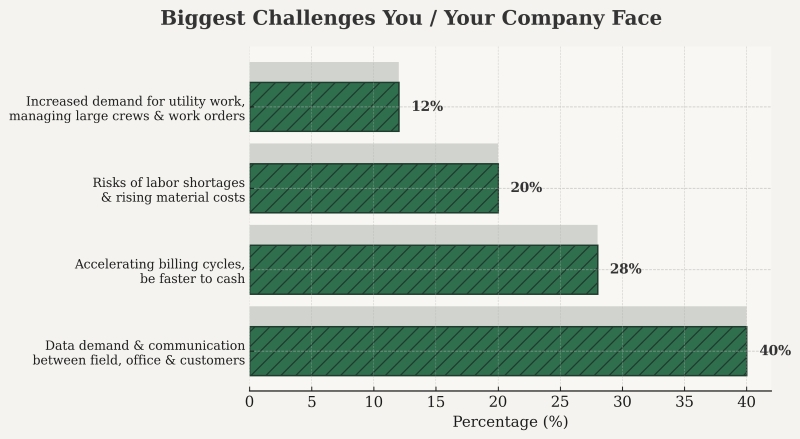
According to Senior Product Manager Frank Baumgartner, even the industry’s top performers still struggle with manual, paper-heavy workflows and disconnected systems. During a live poll, attendees confirmed that despite years of digital transformation efforts, the biggest challenge today is still communication and data flow between the field and the office, as well as their customers.
Baumgartner broke the challenges into five major buckets:
1. Slow turnaround on massive work-order volume: MSAs and utility work can bring in thousands of work orders. Intake often arrives as PDFs, emails, or spreadsheets, making it difficult to distribute efficiently or prepare jobs for field crews.
2. Paperwork and manual processes overwhelm teams: When crews and office teams don’t have clear visibility into contract pay items, they can miss quantities, skip documentation, or lose track of billable work, creating revenue leaks.
3. Delays and errors ripple into billing: Slow intake and inconsistent data lead to slow invoicing, incorrect quantities, and rejected bills. This can drag out payment cycles that some contractors are trying to shorten from 60-90 days to weekly or even daily billing.
4. Limited visibility makes forecasting difficult: Disconnected data makes it hard to evaluate crew performance, track margins, or forecast revenue against POs.
5. Homegrown technology can’t keep up: Many contractors built their own once-innovative systems years ago, only to find they can no longer support or scale them.
Driving Real Value Through Practical Digital Tools
When contractors pair well-defined processes with the right digital tools, the payoff is not only immediate but also measurable. Let’s say your company uses the new HCSS bulk work order import tool and automates the intake of 15,000 work orders.
A utility customer recently did this and cut weeks of manual setup down to three hours.
A move of this caliber will fundamentally transform how quickly your teams can execute and invoice work. Just remember, these wins aren’t accidental. They come from a deliberate shift in how top-performing utility contractors structure their data, workflows, and technology choices.
The most successful organizations start by simplifying what they ask their people to do. Instead of forcing field crews to scroll through massive rate sheets or guess which codes apply to which tasks, they build standardized libraries and intelligent filters so the app guides the foreman instead of the other way around.
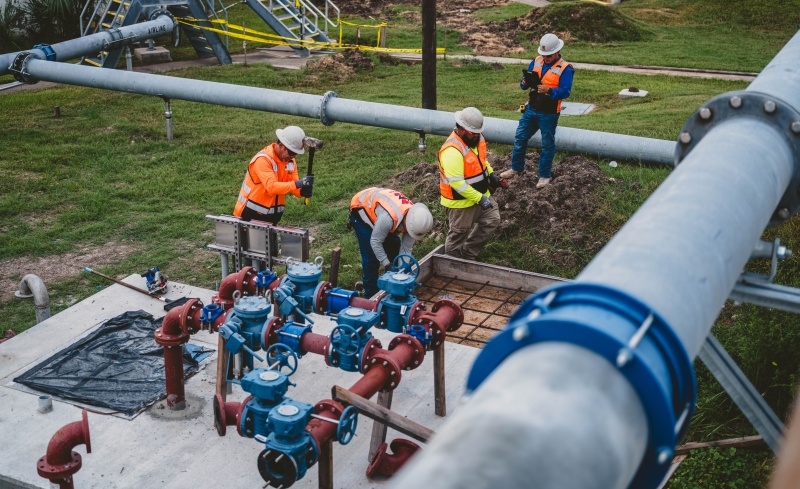
These same leaders also embrace automation in every place where it meaningfully reduces friction. Bulk imports, API integrations, and well-structured templates ensure that data flows into the system cleanly and consistently—whether that’s a month’s worth of new work orders or a batch of pay items from a customer. Faster setup means faster execution, and faster execution means faster cash.
A crucial enabler of all this progress is a willingness to use proven, off-the-shelf technology rather than trying to custom-build everything. As emphasized in the webinar, consistency is what turns isolated wins into enterprise-wide improvements.
For small to mid-sized contractors, especially, this should be encouraging. A major misconception is that digital transformation requires a large IT staff. It doesn’t. Tools like HeavyJob and HeavyBid already include configurable options, so contractors can start with one workflow (payroll, quantities, safety forms, or billing) and expand from there.
Final Takeaways for Utility Contractors
Baumgartner closed the discussion with three essential takeaways for utility and infrastructure leaders:
1. Streamline work orders through standardized digital workflows.
2. Connect field data to billing to accelerate cash flow and eliminate errors.
3. Empower your crews with mobile tools that cut admin time and boost productivity.
View the Full Webinar and Don’t Hesitate to Reach Out
Be sure to watch this recent ENR webinar in its entirety. You can also try out HeavyJob by getting instant access now.
Hello and welcome to this webinar, Powering Infrastructure Projects, Streamline Work Orders, Billing, and Field Data. This event is brought to you by Engineering News Record and is sponsored by HCSS. Hi. I'm Adam Palant, special sections manager at ENR and your moderator for today's webinar. Thanks for joining us. Now today, we will discuss how leading infrastructure and utility contractors are overcoming challenges like short cycle work orders, accurate billing, and crew productivity with technology that connects to field and office. So let's get to know our presenters. Stuart Falkner is the sales director for the utility division at HCSS. With over thirty years of construction and technology, including fifteen years as a general contractor managing two billion in projects, Stuart brings deep industry insight. In his thirteen I'm sorry, fourteen years at HCSS, he has helped civil contractors improve their people, processes, and technology across estimating operations and fleet. Frank Baumgartner is a senior product manager at HCSS, and with fifteen years of experience in software for infrastructure construction and utility services, Frank focuses on building field first tools that streamline operations and boost efficiency. He works closely with utility contractors to ensure HCSS solutions meet the industry's real world needs. I'll be rejoining our presenters at the end to answer any of your questions that come in throughout the webinar, so don't forget to submit them in the q and a section of the webinar console. And now I'll pass it over to Stuart and Frank to kick off today's presentation. Thanks, Adam. Appreciate it. So, Stuart Falknor here. We got Frank. You can see us on camera there. We're gonna kind of break, the the the presentation down into two areas today. I'm going to speak about the broader market and the trends that we're seeing from that infrastructure, that utility infrastructure market that we're heavily involved in. Then once we kind of see where the trends and the growth are kind of why we're seeing those, we're going to turn it over to Frank. And Frank's going to talk about the strategy and the tactics and the blocking and tackling that our customers are using to go out and perform this work and document it well. So that's what the goal is today. That's what we're going to do. So kicking off that part of the conversation, that larger market conversation. Here at HCSS, represent, we have about five thousand construction customers. Those customers are, it's not the broad construction market. You can see here forty five of the top fifty heavy civil contractors are customers, fifteen of the top twenty utility contractors. And so when we speak about our industry trends and our customers and how they're doing things, we're really talking about this segment of the market. We're talking about infrastructure, we're talking about dirt, we're talking about utilities, we're talking about concrete, airports, roads and bridges and those sorts of things. I kind of thought in place of why should you be listening to HSS? Really the way I think about our place in the market is when the way we see the data come through and the way our contractors manage their projects, to me it's really analogous to the way we listen to ADP and they come out with their quarterly projections for unemployment and payroll roles and growth and those sorts of things. ADP is really a proxy for what we're going to see in a couple of months from federal unemployment and employment reporting and those sorts of things. I think of HSS the same way. We are a very good proxy for what this part of the construction industry is doing. The key thing that I want to touch on here is this utility piece that we call you, the way we market utilities, the way we think about utilities is very dissimilar to the way ENR buckets utility contractors. So I think we were really aligned the way we think about that. And I think it's funny we took, next year is our fortieth anniversary. It took us thirty nine years to build up that forty five of the top fifty heavy civil contractors. Concentrated Frank's team started about two, two and a half years ago really concentrating on some different workflows that utilities needs that are really unique to that market. And so it took us thirty nine years plus to build up the forty five number there. We've built up that fifteen number in this market space in a year and a half, two years. So really proud of that and really kind of creating those needs. Breaking those utility numbers down, let's see here, go to the next slide. What we are seeing from a trending standpoint, and some of these numbers are ENR numbers that we can back up that we're seeing as well. Some of these are our numbers that are very close to ENR's numbers as well. So I think we're aligned with what we're seeing. A breakdown of what we think of as utility infrastructure contractors here, we're seeing about a ten percent year over year gain in the pure utility sector. And then so the contractors that we think of that market, electrical and gas transmission, the underground electrical gas, water infrastructure. So what we're seeing in that market is system updates, system hardening, system replacements. So we went through a period a couple of, probably a decade ago, where water was really in the focus, Flint, Michigan's water problems, those sorts of things. And then now, if you think about the recent, it's maybe more on our mind than anybody because we're in Texas, but the ERCOT with the Texas, we had the freezes and the ERCOT power grid shut down. And so since then, what we're seeing when we get out in our cars in Texas and we drive, plus we're seeing in the data with our contractors, is we're seeing a rebuilding of that electrical infrastructure. You could drive all over Texas, you see big electrical transmission lines out there doing those sorts of things. So I haven't heard much talk about it politically. I'm proud that our group has not made it a political hot potato for that electrical infrastructure, but we're seeing with our eyes and we see it when we drive around that they're bolstering that system. That really is closely aligned with the power market. When we think about pure power market, and we've got that electrical contractor, the Qantas, the Centuries, those types of customers with business units that are pure power, we're seeing larger growth, almost twenty five percent year over year growth there. So again, we see some of that modernization of some aging infrastructure. We're also seeing renewables everywhere, but we also about again, I'm at IC Texas, everywhere I go, I've got solar farms that need to be connected to the grid to get that power to the end user. I come from the Gulf Coast of Texas, my hometown, Bay City, Matagorda County, and we're seeing wind everywhere. Again, all of that needs to be connected to the grid to bring that power to the market. So we're seeing those sorts of things as well. And then again, just the upsizing of this market. I mentioned a couple of things. We see a Samsung chip factory, semiconductor factory in Taylor, Texas, and I drive by there and around there. Again, massive power that that type of industry needs. And we're seeing data center in our tech of the world, just like every neck of the world going crazy, massive amounts of power, massive amounts of water. So they're bumping that utility in that water sector up in that first number as well. Then to me, they're also responsible for this huge gain in telecom construction here, sixty five percent year over year over the last. So we say, hey, the new race, the arms races in AI infrastructure, AI computing power with these data centers, it's reasonable to say that we have to get that data in and out of those data centers quickly and efficiently, just like power to the end users that are using that computing power. So those are the trends that we're seeing specifically in the utility market. And so through our customers, through, you know, they grow the way we grow. And so that's what we're seeing there. Next slide I'll go to here. Just a different presentation of that. We were looking at numbers before. This is the graphic side of that. If you like to, if understand it and the weight of those things better on the graph side, I think these two slides are telling the same story from where we're going there. So that's the broader market side of that I think I want to turn it over to Frank right here and let him start to give some of that blocking and tackling that's going on with our customers and how they're using software and how they're using software in general to manage some of this increase of work that we're seeing. You, Stuart. Thank you, Adam, for kicking us off, kind of setting the stage for kind of where we see the market, but also how HCSS has paid attention to that market and learned from it. I think that's one of the important things that I want you to think about as we go through the rest of, these topics is that HSS would like to, think that we have learned a lot from folks like y'all over a lot of years. And so we have a lot to share. And we've learned it directly from the source directly from the boots on the ground, the companies that are out there struggling and making money. So that's what we hope to do here. You know, first objective. So we want to talk about some of the trends or you could think of these as challenges that shape the way utilities contractors are working, and the kinds of changes that they're prioritizing, the kind of improvements they're prioritizing. Second, let's talk about some specific workflows that we see the top performing teams out there. Again, that, that image that Stuart showed of HCSS having, most of the top of the market, across construction and especially the utility space means that we are working very closely with some of the top performers or the top performers and we've got a lot of lessons learned. While I couldn't drop people's names and give you their IP, we have a lot of generalized learnings that are useful to share. And third, let's look at some very kind of broader best practices, not just what works at one company, but in general some things that you could think about as a best practice to kind of stimulate problem solving at your company. Let's go into a poll first just to get some of your input on what the biggest challenges are that you're facing. I know it's hard to pick just one. I'll let you all read that a little bit. But we want to see what are the what do you think is like the most pressing challenge? That first one, you can think about these labor shortages and material costs, know, especially since COVID. There were material shortages from supply chains, we had labor risks from people not being out there. Now we've got government policy that's also impacting these with tariffs and, our policies at the borders. So that's probably on a lot of people's minds. Can already see those numbers are moving up quickly over there. That second one just has to do with the fact that utilities work, especially short cycle work is in demand as energy demand goes up, especially with things like AI and hardening projects. A lot of y'all have been doing bigger capital projects and you're kind of mixing in some of the shorter cycle MSA work, smooth out the cash flow curves. So expect to see some people are just struggling to to manage that inflow and that change. When it comes to billing, you know, is king. The closer you can bring your revenues to your costs and time, the better you can manage your cash. So, we see a lot of people talking about just wanting to accelerate their billing cycles. Sixty day, ninety day billing cycles, ideally wanting to get those down to week, days, a day. Then that last one is just it's a digital error, right? It almost feels tiring to say that, but a lot of companies are still coming out of paper and manual workflows and the data demands between their customers and them are tough, tough to manage. And so we see a lot of demands of communications and data, not just between the field and office, but between y'all and your customers. Have they stopped moving quite as much? I think so. Let's, let's look at the results. Looks like we started off with a big hit on the risks of labor shortages on and then it kind of smoothed out and the data demands and communication between field office and customers has has won the race. But it's obviously a pretty smooth distribution there. That's interesting. I wonder if we did this again and give gave you all a ranked ranked vote if it would still play out as number four, number three, and number one at the top. All right, thanks for that. We're gonna we're gonna hit on some of these topics as we keep moving forward. Stuart, let me pause there. Does this surprise you what these results were? I don't think so. I guess a little bit. I would have thought that this far into the digital transformation age that people felt more comfortable about their communication between field and office and customers. But I'll also counter my own argument there say that it's never good enough, And that we're always striving to get better. So that may be something that we're always reaching for. A little bit, but I could talk myself into not being surprised about it. I'm going to be honest with you all, Stuart and I did not plan what he just said. And I think that's an excellent segue into the next slide because one of the things that I thought about as I was prepping for this is exactly that point. It sometimes feels tiring to keep talking about the digital transformation and getting away from paper and manual processes. The reality is some of the best performers in the country among our customer base are still right there. They're making lots of transformations, lots of improvements, but they still very much feel the pains of, of using paper, working with vendors that use paper, working with Excel and emails and text messages. So it feels like we should be out of it. But by no means is that true. It's a, it's a long, difficult process. So that's why we're that's why we're here talking. So let's talk about, some of the most common challenges that we see, from our customer base. One, just to kind of give some context to this, you know, when we if you hear me say short cycle, if I say that out loud, we use that for I imagine most of you all gather what that means. If you take these big capital projects, bid projects, lump sum, you may be progress billing those. That's kind of what the contract looks like. And then on the other side, you've got your MSAs, your indefinite quantity projects, indefinite duration, work orders, MSA projects, services work. So that's when I say short cycle, I'm I'm saying that second one. What we see is people are are doing more of that business together. There's some really big companies out there. They're taking on huge MSA contracts or lots of those. There's lots of smaller companies who are taking on the same kind of work, but maybe more at a single municipality. It could look more like ticketed work as opposed to big contracts for like big residential areas, getting service connections, getting lead replacement programs, hardening programs, undergrounding, right? So we see companies merging these two on these two different contractual styles, two different ways of managing your business, two different cash flows. And that first bullet point, just the huge volume of work orders that can come in through one of these short cycle contracts is a very different look than managing a big capital project. It's a different margin. It's a different way for the field to work. And because of these huge volumes that they're dealing with, what ends up happening is they just get bogged down in managing it and it slows down the turnaround. And the turnaround could be anywhere in the process. If you just go end to end, absolutely, you receive work and that's when your costs start happening. And at the very end, want to get paid and you want to bring those two together as much as possible. But even at a kind of a macro level within that whole workflow, you see the turnaround just from work intake to getting work into the system. You may be getting work in emails from a utility customer. They may be sending you spreadsheets or PDFs. Some of y'all might be integrated, with their enterprise systems for work release. But once those come in, how do you get it in front of your people to work with stripping stuff out of emails and PDFs? So that's a huge challenge. It's just getting work ready to be touched and manipulated. And then you talk about getting it into the field so that the field, can do their pre fielding and get a shovel ready. If you can't do that quickly, then somebody can't get out in the field and scope it out and see what are we gonna have to do out here? Are the work items we're gonna do? What are the risks out here? What are the things getting in the way? Are trees in the way of where we're building and nobody told us that. There's a house that used to be there and it's missing. We can't do work on a missing house. We hear these kinds of crazy stories. They get out in the field and stuff's not there. And so like just slowing down getting work into the system so you can start that complicated process of getting it in front of all the people, is a huge hassle. And it ultimately cause you to not be able to turn work around and get paid really quickly. The second common challenge that we see is, that paperwork is just overwhelming, crews, office folks. And because of that, everything slows down. And when everything slows down, they start to get behind the gun. There's costs, they're behind schedule, they start to take shortcuts, they start to move too fast, they don't execute their processes. Now you get mistakes. When you get mistakes, you start to get revenue leaks. And by revenue leaks, I mean, there's something that you could be making money off of and you literally lost track of it or you literally forgot to write it down, especially that forgot to write it down bullet point is we see that happening in the field because the field doesn't always know what the contract is. They don't know exactly what they need to record or the impact of that. And it gets complicated by the amount of paperwork. And when I say paperwork, it doesn't have to be strictly paper, right? It could be stuff that's coming in over emails, PDFs, Excel documents. But these are things that are not that easy to work with when you're moving them around from the customer to the office to the field, because they're not all connected, right? You share an excel doc and now you have either two different documents that you're working off of or a shared document that's too easily manipulable and it can get out of sync. So big challenge there is just how do you take all these kind of old ways of working, written paper, written tickets, things having to be picked up and dropped off at the office, things going over emails and getting lost. How do you take all that stuff and simplify it so that we actually capture all the data we need to capture? We get it right, and specifically, we don't miss billable revenue. This third point, delays and errors in invoicing is just a direct result of those first two. When you can't intake work quickly and efficiently and push it through the process, when it's difficult to work with, you end up just slowing down the invoicing process, which means you're going to be a lot slower to cash. These errors in invoicing we see kind of trickle through the system. You may actually get invoices out the door and you realize two weeks later, that you invoiced an incorrect quantity. You used a wrong, pay item from your contract. You used a rate that came out at a thousand each and it should have been a hundred and now you've overbilled and you have to go issue a credit. Maybe you caught this. Maybe the customer caught this. So all these challenges that put you all under stress and give you lots of, kind of manual reviews and create errors, all of these things compile into eventually being discovered in the billing process. As a side note, impacts your costs too, but I imagine your customers not taking a close look at your costs and telling you to shape up your bottom line. But they are taking a look at your revenue and what you're billing them. And so that's why I kind of emphasize that revenue side is that's what the customer is probably most caring about. That next bullet point limited visibility makes forecasting difficult. So think of all this data flowing in and you're trying to take a look at crew performance. How many units per labor hour are we doing? How many work orders of kind of the same type? You're doing, I don't know, gas service connects in volume, you can kind of look at those as a trackable item and say how efficient are we at that? How much are our costs? How much are we billing for those? Are we keeping a steady margin on those? Are our margins reflecting, our unit rates that we put into the contract and we're going to be locked into for this next six months to a year? Looking at not only crew performance, looking at your financial performance. How much are we billing daily? How much we do billing weekly? How are we doing against our purchase orders? And then looking at the cost side, so you can see your margins. So all of this stuff, all this data can be flowing through. If if only you didn't have some of these other challenges up top, especially around the data quality. And then last, this homegrown technology can't keep up. This is one that we often don't talk about, but we hear it from customers when they first come to us and then we forget about it. And that's people using homegrown solutions, whether it's, again, paper, email, Excel documents, or they've actually built their own system. There's quite a few of our customers that have built their own solutions and we're essentially talking to them because they have discovered that they can't keep up with the maintenance and the improvement of that technology. And so they feel like they're getting behind or they're maybe not so much getting behind, but they're seeing the risk of lower margins because they're spending a bunch of money maintaining a system when that's not necessarily their area of expertise. Either that one out there, HCSS is a technology company, provide, you know, mostly software solutions, some hardware solutions, that's where our expertise is. We are not experts at, you know, building network infrastructure, we contract that out in our offices. And it's the same story for a lot of our customers. They're not experts at building technology. So they find themselves in a position of being challenged as that technology ages, and their company depends on it. Alright. Frank, I make the I make the joke when I'm talking to a to a new customer, taking a look at HCSS that's built their own system. I said, you always end up at some point you don't put the resources in to keep it up to date like you should and you end up with that avocado lime green appliance and the shag carpet version of software. So we see that often. That's right. We do. And by the way, we're almost always impressed with what customers have built. But nonetheless, I mean, we do this every day and we realize how difficult it is. So when they come to us and say, we've done this really great thing, and it exactly matches what we want, but we can't maintain it. We get it. We're impressed by what you've done and we feel your pain. So with those kinds of challenges in mind, what's needed to stay competitive? You can think of this question as what, what do we have to do to meet those challenges so that it doesn't eat our lunch? That first, bullet point on the previous slide had to do with kind of a slow turnaround due to the high volume of work. One of the first things you got to think about is how do I automate, right? I mean, here we are, we're talking about technology. So let's talk about automation. Automating the intake of work from your customer to you, to your office staff, to your field, to your vendors, back to the office, back to your customer for inspection, to your AP and AR teams, to your customers AP team, you want to get paid. Automating those workflows can pay huge benefits. Not can't, it will absolutely pay huge benefits. This is one of the key things that we see our most successful customers paying attention to. How do we automate? And some of those most successful ones, it means that they also have superior profit margins, because of their success. And that means that they have money to spend. And this is a place that we see them, a problem we see them prioritizing tackling is how do we automate workflows. An interesting part of this one, is also that automating often involves bringing multiple systems together, systems that use a customer don't own, but some vendor does or your customer does. Systems that we HCSS don't own your system, your vendor system, your customer system. So the integration topic is a big one. There's a lot of value to be gained. One of the one of the major topics that, has come up in in the Internet age, which is, you know, that was a long time ago when we talked about being in the Internet age, is that integrations allow you to take advantage of the best of breed solutions out there and not being pinned in, to only, that one little ecosystem that you own. And so getting good at automation and integrations is key. The second bullet point, the challenge that we talked about in the previous slide was revenue leaks and kind of the overwhelming paperwork. So real time data capture in the field can hugely reduce this simply because the faster you can get stuff collected and through the system, the faster you can review it. And typically faster happens because you put in some kind of standard, some kind of process that's repeatable and controlled. And you've given the field good tools to collect data in ways that reduces the amount of thinking they have to do about things that aren't really valuable to think about. They're not challenges, they're more just like sifting through long lists of things to pick. The more you can do that you can simplify the more you can reduce the time that they spend. And they can reserve their brainpower and their effort for the more valuable things that the humans do for you. And this reduces the air. And then that flows all the way back to getting rid of some of the problems that ultimately causes revenue leaks. Third is connected systems. So I've already kind of, you know, said this over and over and over at this point about the office, to the field, to your inspectors, to your customers. Connecting these systems, is key if you want to be able to move things through faster. And this gets to the idea of you can't have a fast cash flow if you can't actually move your information through the system faster. And so we see people trying to tackle this challenge of how do I just speed up my invoicing cycles by connecting all of these little pieces So that rather than me having to fill in a paper ticket and drive it back to the office, and it sits in a tray, and then an inspector comes in later that week and they pick it up and they go back out to the field, this taking a long time. Or the same thing can happen with emails. They just get lost in the shuffle. How do we connect these things digitally so that people are making decisions and sharing information basically right at the moment that they collect it and they hit submit? This fourth point, crew and profit performance analytics. So we were talking about the limited visibility of data, and this makes forecasting difficult. But when you can gather all of this data, like these previous bullet points talked about, you can automate workflows, you can put tools in the hands of the field to gather data right in the moment and record it correctly and get it sent in, you can connect those systems. What that does is it provides all this great data, right? And it's standardized. It's not, written on a piece of paper where it's very difficult to pull out and report against. It's not typed into excel where everybody can type something different. It's standardized. This data provides great data about who your crews are, the kind of work they're doing, when they were doing it, the quantities that they're reporting from a cost perspective. You can think about the payroll hours, the equipment hours, utilization, material quantities, your pay item, quantities that you're going to bill, all of these things being collected with basically timestamps on them, right? Allows you to go figure out how's my crew performing for my crews that are doing, service connects, gas service connects, which crew is performing the best and why? Are they using, hydrovac sub, that is more costly and less efficient than we pull our own crews out there or vice versa? So getting this data in is going to provide better data, and then getting that into some kind of reporting so that you can see how are your crews doing? How's your how's your cost performance? And what do your margins look like? And we're gonna talk later about like how fast you should be thinking about doing that. This last bullet bullet point is just this goes to that topic of if you are rolling out your own software, you have your own processes, trying to find a way to get to industry standard solutions, best practices and using the expertise of the many people out there who are already doing things is a huge value. So to the point of kind of the title of this slide staying competitive, one challenge is that a, strategically advantaged company is not gonna do everything like everybody else. Their strategy is how to do it different and better to win that battle. But at the same time, if you roll everything your own, you're gonna be spending a lot of cash and time building out solutions that the rest of the industry has already standardized on. So there's a balance there. But one of the things we do see some of our biggest customers, most successful customers doing is they are, the ones that are most likely to have come with their own homegrown solutions. And they're the ones acknowledging that this is too expensive. This is too hard to maintain. We can't keep up Smaller, more nimble companies are catching up. So finding a way to leverage the right industry standard solutions, is key for them. I'm gonna pause and take a breath and not keep talking just too fast so y'all can digest before I move on to the next slide. Frank, I'm gonna throw some real world examples of these right here real quick. Yeah. The automated intake of digital work orders. My favorite story from twenty twenty five so far is that we had a customer come to us that was released on fifteen thousand work orders. I think they were meter inspections or meter replacements in a quadrant of a good sized city from the municipality or the electrical co op or whatever it was. He had done that previously in our software. It had taken three people two to three weeks to get those fifteen thousand work orders set up properly in the previous system. Frank's team got together. They built what we call a bulk work order import tool that we rolled out in January for them. They uploaded fifteen thousand work orders, individual addresses, lat longs, unique numbers, references to common PO numbers and work order releases, all those sorts of things that every company has. They released the tool. They did that in three hours. I think the guy that called us was almost crying. He was like, Oh my God, I never dreamed we could get this done in three hours instead of three people taking three weeks. That's one example that I love from this year. The second thing, when we think about field data, connected systems, field and office, what we see with market data across all of our platforms, we have about one hundred, depending on time of year seasonality, one hundred to one hundred and twenty thousand Foreman or crew leads in our field app every day. We have, if you understand our field app, pictures and diary notes, and they're filling out forms and vacation requests and disciplinary forms and MOT and SWIP inspections and time card information and pay item quantities. Those one hundred to one hundred and twenty thousand form in a day capture all that information in our field app on average in North America in nine point one to nine point two minutes a day. So we think about the speed of capturing that information versus the old way, whether it's a spreadsheet or a Dropbox folder or paper for God bid and then running that back to the office and the time it takes to drop that off or do those sorts of things. You see this level of data that's captured, the quality of it, and the foreman is doing that in less than ten minutes a day. He was spending thirty to thirty two minutes a day doing that before, so we've returned twenty something minutes of a day back to that foreman to drive production, to drive quality, to drive safety, which should be more important to our business than the paperwork. So I think those are two kind of factoid numbers that I think back up these statements right here of what the opportunity is to advantage of. Yeah, love that first example because I can remember exactly that customer and exactly that administrative person in the office and exactly that comment of they were literally a little teary and they get they sent us a quote and it was something like not to get your list but it's like you know something like praise Jesus this is the best day I've had in in months of not having to push so many buttons to get this stuff through the system. It's true that there's a lot to be gained by giving people the tools to do things that machines could do for us so we don't have to tire out our knuckles typing so much. So here we're going to hit the same themes again but talk more specifically about what specific examples like the ones that steward just gave about how utility contractors some of the top performers are actually adapting. So you know we talked about the challenges. We talked about like what you kind of need to do at a broad level to meet those challenges and then let's talk about some of the specifics. So Stuart's first one hits the nail on the head. When you're talking about integrating and simplifying, what you're looking for is tools that allow the machines to do the work. Bulk import tools, we see a lot of folks trying to use API integrations to write their own integrations or getting out there with integration partners. We provide integration services as well. And the whole idea is how can I pull information out of the source whether it's my customers work release or just out of spreadsheets and emails and pump those into the system? So we absolutely see people using things like bulk imports and API integrations to push thousands of work orders in, sometimes in bulk up front, but that's usually more on like the week to month schedule, a couple hundred a day, and getting those things properly set up in an automated way so that they're all set up correctly. This just allows them to get to shovel ready even faster. The second point about standardizing, in order to make it easier for your users, your field especially, to not make mistakes and not have to spend so much time figuring out what to collect and what to do. Some examples are we see people building out, libraries of their billable items. So if you think of like, in your contract rate sheet building out those libraries, adding all kinds of filters to those so that you understand which types of pay items go with specific types of work and specific types of areas. Putting filters on those for the contracts so that when your field gets out there and they're on the hook for recording that they did one hundred feet of two inch pipe. They had elbow connectors on that. They had to do a service disconnect. They had to do a service reconnect later. They had some restoration work and they've got a rate sheet of a thousand items long and they really only need to pick from about ten of those. How do you do that? And we see folks taking those big rate sheets, whittling them way down, putting only the ones that are most necessary in front of their crews and making those easily searchable and filterable so that crews can answer basic questions like, are you doing a service connect today? Yes. Okay. Boom. Here's the kind of stuff that you're going to need to pay attention to. So standardizing the way that people look at data and select data can go a long ways to making it easier for them to select the right things and not end up missing revenue. When we look at digital workflows, I underline daily because I cannot emphasize how impressed I am about people who have these ninety day billing cycles and they want to bring them down to a day to get the invoices out the door. Now we can't necessarily solve that you've got a net thirty term on your contract, but we see people digitizing their workflows so that they can get a work order out into the field, get that work order executed in four hours and get that back into the office where the office can run a report for a daily field report. That daily field report's auto generated. They can send that off to an inspector. The inspector reads through that they get it on their phone while they're in the field they can sign off and they're off to the races getting that approval to bill back into the office. And the office can go run their AR reports that evening or that next morning and generate invoices go grab their documentation get invoices out the door and all that data they gathered is in reports that they can include in the job package to get their invoice actually approved and get paid. So their ability to get this stuff into digital and create standardized reports and standardized data collection is a huge benefit for getting this stuff right and getting it to flow through the system faster. We see automating those daily reports on cycle times and costs and revenues and profits. This is literally thinking about reporting dashboards. If you've done a good job collecting all this data and you can go one click get your reports showing in front of you so that you can see which crews are performing, which contracts are in the red where you've got AP delays and that AP needs to pass through the revenue and so you're not collecting. When you can see all that kind of stuff right in front of you it's a huge benefit to knowing which problems you need to go squash. And we do see some of our customers who are really embracing integrations and tools like Power BI to pull that data in and generate these dashboards so they have very quick decision making. We see this as a big benefit for them. And lastly off the shelf technology. We talked about this but some very specific instances where folks have come to us with a solution that their entire enterprise is using their entire enterprise. And they have to find ways to basically adapt to an off the shelf solution, which means you're not going to get a hundred percent of what you want out of that solution. That's a painful thing for us software providers to say out loud, but it's true. But the flip side is you get this tremendous efficiency by using something that is standardized as well accepted. It has been used by many other customers in the industry. You know it's going to work. You have evidence of that out in the market. So we see some of these top performers acknowledging that and coming in and saying we're going to take the trade offs to use a proven solution. And for that we'll adapt our processes a little bit. You don't want to adapt your processes too much. All right I'm going to move on because I know that we're at about the forty one minute mark. Let's hit a quick poll. I want to understand how long it takes y'all to bill your work after completion. Think about when you actually go shovel down and you get data into your, billing team. How long does it take you to to kinda get that to where you can get it out the door? One to two weeks immediately got a hit. Let's see what other people have to say on this one. Nobody's saying less than three days, two plus weeks. Not surprised by the bigger numbers. That's what I would expect. I'm actually happy to see that we're, that one to two weeks is winning and not two plus weeks. We hear, there's this one great example from a couple years ago. This is an oil and gas customer that came to us and said, it's taking us ninety days to get paid. And that I don't remember the the number, Stuart, but it was millions of dollars. I'm trying to remember the exact number so that sounds more credible, but I don't have it on the tip of my tongue. But it was millions of dollars in AR that they were waiting on at ninety days, and they needed to shave that down to more like two weeks. And today, that's where they are. So they would have been one of these two plus weeks by a long shot. Alright. One to two weeks is definitely, winning here. So we're gonna move on from that one. Yep. And that's where we're at. Sixty eight percent at one to two weeks. Alright. So this is just starting to wrap us up a little bit. We've hit on these points about how if you can modernize your operations you can think about your revenue, you can think about your data. Ultimately if you can streamline your processes for collecting data and getting it back into the office to report on, you can reduce a lot of the stresses and errors that come from that. That directly rolls into your ability to accelerate your billing cycles. And in the previous slide, I had underlined daily. I think this is key. There's a lot of folks out there that want to invoice daily, and they don't think they can get there. But if you can accelerate your billing cycles by having tighter workflows, tighter data collection, and rules around that to reduce errors, you can get from weeks down to days. And that is a specific thing that we have worked with a lot of customers on, and have seen successes with folks that are literally asking, can I invoice this this afternoon? Improving the visibility of your data starts with better data collection and starts with better workflows. Once you get that quality data flowing through, then you can improve the visibility of that by giving people the tools, whether it's web apps, whether it's mobile apps, or whether it's reporting dashboards that allows them to get to that stuff. So you got to think about how do I first improve my processes and something we talked about a little bit earlier is it's not just improve but it's also simplify. Right? We always feel for our field foremen who have dirty gloves. They're sweating up there and they need things to be simplified for them so that they don't have to, deal with huge lists of cost codes and pay items and recordables. So if you can simplify that for them, you're also going to improve your ability to get data through the system. And lastly, you can replicate these successes if you can standardize. And this is where we like to talk about off the shelf solutions. So off the shelf solutions help you standardize. And when you can do that, you can take a process that's working in one business unit and replicate it somewhere else. You don't have to reinvent it. So we highly recommend people look for opportunities to learn from those that have come before them and found successes and see if you can replicate that. Yeah, we often correct customers or prospects coming in. Our software is highly configurable. It is not customizable. So there's a nuance between those two words that means a lot to price of technology and it means a lot to the end result and be able to benchmark yourself against other markets, other companies in other markets. Configurable, not customizable. Seems counterintuitive, it may be better for most companies. Absolutely. Well, let's wrap this up before we hand it back to our ENR host, Adam. If there are three takeaways that you come away with today for your utility market, streamline your work order intake. Streamline that intake. The better you can start off, the faster you can get things set up correctly, the faster you can get work shovel ready, and the faster you can ultimately get work done and get it back, and billable. Second of all is focus on accelerating your cash flow. Not everybody recognizes this as a problem, but if you do accelerate your cash flow is because you're doing a lot of other things correctly. You are connecting systems, you're giving people easier tools to work with, you're giving them tools that are less error prone. These are the key stepping stones to ultimately being faster to cache. So if you find yourself getting faster to cache, you're probably doing a lot of other things right. And last is we want to empower our crews with mobile tools that cut down on time and boost their productivity. So I read that one right off and it sounds nice. But ultimately those crews, those are the lifeblood of most companies. They're doing the work and making their lives easier so they can collect good data and go do good work is critical. And we see our most successful customers often giving us a first requirement that they make sure that their crews are well enabled and that the tools are easy for their crews to understand and use. This is a huge, huge leverage point for successful customers. I think we're wrapping it up there. Adam, you want to take us away? Absolutely, absolutely. Thank you both. This has been a great presentation. Now, before we address your questions that have come in throughout the webinar, I want to remind you that we would love your feedback. Please take a few moments to complete our survey, which you will see on your screen now, or you'll be redirected to it at the end of the program. So yeah, let's get to our first question. First one, how can smaller or regional utility contractors start adopting these digital workflows without needing a big IT overhaul? Think that comes back For the concept? I think it really comes back to the belief that you need a big IT staff to do these sorts of things. When you come to a configurable, mostly out of the box solution like HCSS, we can say, don't need a big IT staff. We've handled all of those things that you hear about that you may or may not know how to execute. API integrations and moving data, file transfers, and all these sorts of things. Choose a vendor that you're comfortable with. Let them handle the moving of that data. And you shouldn't need a big IT staff to implement parts and pieces or any or all of these sorts of systems. I think another thing to think about is that we will see customers come in with a list of twenty things that they want to accomplish. And a reality is that they probably need to take some steps. They probably need to work on their top three problems. Take those bites. And that gives you an opportunity to learn and to grow. So a lot of people start off with payroll. It's a huge call center. It's a huge risk and you got to take care of your crews. You got to take care of your people. We see folks focusing on getting correct quantities into the system because that's ultimately how they track their production and they track their billings. And starting with a few of those things, to Stuart's point, doesn't require that you have a huge IT staff, fancy integrations. Those are tools that you can use right out of the box. And we also provide ways for people to work with volume data without having to have your own integration teams, for instance. So I do think if people think about like if if you feel like, oh, we're not that mature to do some of these things with technology, keep in mind that you're probably not unlike anybody else. Lots of folks have to take some small bites and kind of work their way into it and get good at something and then take the next bite. By that point, you'll feel more confident. You'll feel more capable. There you go. That's outstanding. Thank you. Now, early on, you mentioned billing delays. What are the most common reasons contractors get stuck, Darren, and how are top performers overcoming them? I can hit that one. Stuart can certainly provide some color. So aside from I think I mentioned this earlier aside from like your contractual terms or you're like a net thirty, net forty five, those kinds of things could certainly be changed. There's expectations in the industry of things like that that don't acknowledge that they could be moving much faster. Where we see the ability to control how you move faster, it one starts with, and I feel like I'm going to be repeating this, hitting some some key bullet points, is you got to get work into the system faster. You've got to get shovel ready faster. Two, you've got to standardize and simplify data collection for your field. If they're collecting labor hours, equipment hours, material quantities that are both cost centers and they're billable, pay item quantities that you're going to directly bill. If you can simplify those and standardize those and give Cruise Team apps that are easy to work with and super easy to literally type in the critical things they need in like that nine to ten minute window that Stuart talked about. That's huge because if you can cut down on errors, you cut down on the back and forth process between the field and the office and from the office to inspectors and then from the AR team, your billing team to your customer is going to approve that billing. The biggest billing delays that we see from people is just in errors that are caused by frustrations and like slow and confusing data entry. Those errors just trickle throughout the system. And you can imagine how later on if you actually get through billing and you pay for something or you get paid for something and then it's incorrect, now you have to go execute that process again for credits. So getting rid of those errors is key. Yeah, yeah, that's outstanding. A good question. It all depends on your perspective. Good question. Are you promoting something in addition to what HCSS currently provides specifically for short cycle work? Or is this showing how HCSS can assist with this work? Stuart, you wanna take that? I'm not sure I totally understand the nuance of the question. We are not promoting anything new. We don't have any new product or anything. This is all about how you could use your existing heavy bit, heavy job workflows with some features that we released back in first quarter of this year. I'll say that, but it's not it's not a new product or anything. The the things that we promoted here today can be done inside our regular heavy bit heavy job safety kind of products that we offer today. Matt, I see your name there. Good question. To Stuart's point, HTSS realized that we have tools that the whole industry uses. But with kind of the growth of utility work, the growing opportunity there, we decided that we wanted to make sure that our existing customers could execute these large capital projects, fixed bid projects just as easily as some of these short cycle MSA contracts. And while you always could the improvements we have made recently over the last couple of years is really to streamline your ability to manage those high volumes of work orders, manage revenue through those billable quantities coming into the field, manage the billing process, Get data into reports and reporting dashboards. So to Stuart's point, these are all things you could do already. What we've done is we have focused on those workflows to make them even easier for your field and your admin staff, your office staff, so that it's just easier. I mean, that's the bottom line, just making it easier for you to do. I think you answered Matt's question on that. So good, another comment came in. For contractors managing both long term projects and short cycle work, what's the best way to standardize reporting without slowing down type? I'm digesting that. Okay. Think the ahead. Oh, good. I was gonna say the the the good part about the way we've attacked this problem is this is a it's not a separate system. It's it's your you you enter a job, you you manage a job, a heavy job. We've given you an option of what we call Mod A or Mod B. Mod A is more of a standard schedule of values, monthly billing project, then Mod B is more of a direct entry pay item. And what's cool about that is, A, don't have to buy another piece of software. B, I don't have to buy any more licenses. But really C is my dashboards, my reporting, my analytics, they all live in the same system, right? And so there are some nuances between the types, but when you set up job A versus job B or type job type B, I can really zone in my reports and I want this report filtered for these type of job, these job tags. So that shows my longer cycle, my capital projects. Then I can rebuild that dashboard with the tag of these type B jobs. I can see those. Because it makes sense to look at those together. It may not make sense to look at a report with type a job and type b job together because the metrics don't really match up. But with tags and analytics and with those two modes, you can really kind of streamline your reporting to show group of capital projects longer term and then analyze your short cycle work order type of work separately and look at that through a different lens with different expectations. Frank, would you have a different answer? No, I totally agree with what you said. And just for folks to keep in mind that payroll process is often going to be roughly the same across the two. And so you can see those as being roughly unified. Your billing processes are often going to look very different between those. And that's where, you know, at ACSS, we make sure that you can execute your billing process for these two different types of work simultaneously. And to Stuart's point, I mean, you're going to be looking at different reporting for those. They operate at a different pace and they have a different way of looking at costs and margins. But then when you want to look at your overall cost for labor and equipment and materials, you know, those are standardized. You can still unify that kind of reporting, to see where your costs lie on a weekly, monthly, daily basis. Outstanding. Outstanding. Well, unfortunately, that is all the time we have for questions today. Please join me in thanking, Stuart Falknor and Frank Baumgartner, as well as today's sponsor, HCSS. Now if you have any additional questions or comments, please do not hesitate to click the email us button on your console, and we will share them with our presenters so they can respond directly to you. If you did not have a chance to fill out earlier, you'll be redirected shortly to the post event survey. We look forward to hearing how to make our programs work better for you. Please visit enr dot com slash webinars for the archive of this presentation to share with your colleagues, as well as information about our upcoming events. Thanks again for trusting us with your time. Have a great day.