
Since the bill was signed in November 2021, the Infrastructure Investment & Jobs Act (IIJA) has authorized $1.2 trillion in infrastructure, including $550 billion in new investment above baseline levels. Money was flowing in. $591 billion of those funds were directed to more than 72,000 projects nationwide — paving roads, repairing bridges, upgrading water systems, modernizing ports, and more. The bill did a great job at filling backlogs and putting crews in the field.
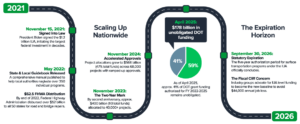
But now, we’re approaching the 11th hour, and with it comes a new set of obstacles.
As of January 2026, 72.6% of DOT-administered IIJA funding has been obligated, with 43% already spent on active construction. But projects still waiting on new discretionary grants are much less certain until Congress acts.
While uncertainty and inflation play a role, there’s still major work to chase in 2026. Contractors need to be ready to bid, staff, plan, and execute quickly. Those who are prepared have a real shot at capturing what is still on the table. Those who wait until fall to level up their operations may be sitting on the sidelines.
IIJA and Its Setbacks in Heavy Construction
Even with the influx of funding and opportunities, the industry isn’t feeling the euphoria of endless profits. No contractor can force paused funding to continue. No contractor can magically solve inflation tomorrow or fix how every public agency moves.
But they can control how they operate.
Labor Shortages are Still Squeezing the Field
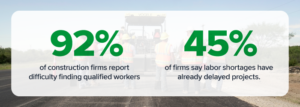
While billions continue to flow into infrastructure, manufacturing, and energy projects, one challenge hangs over the industry going into 2026: Put simply, there aren't enough workers.
The Associated Builders and Contractors (ABC) estimated the construction industry needed about 439,000 additional workers in 2025 just to meet baseline demand, and projections suggest the industry could need close to 499,000 new workers in 2026 as construction spending continues to grow.
When labor is tight, every work hour carries that much more weight. A late time card snowballs into late payroll, which then affects job costing and, inevitably, billing.
Stay Lean or Scale Up: Navigating the Labor Shortage
The labor shortage isn't hitting everybody the same. While some teams need to stay lean, protect margins, and get more out of the people they already have, others see opportunities and growth — looking for the next generation of top talent to propel them.
What's your focus in 2026?
Stay lean & efficient
If hiring people isn't an option right now, the next best move is getting more out of the team you already have. The HCSS platform can keep you lean and efficient. Medium-sized teams don't have the luxury of mistakes. Not with tight margins and rising costs.
With tools like HeavyJob, you get instant visibility into what’s happening across your projects. If something starts drifting off track, you can catch it early and adjust before it turns into a costly problem.
Expand the business
If growth is on your mind, you’ll need to hire the best and brightest to tackle more complex projects. Here’s the catch: They see technology as a ‘must-have’ when looking for employment. It’s a sign of a forward-thinking construction firm. One who values data, automation, and progress.
HCSS software bridges the gap between generations — combining the deep knowledge of veteran contractors with the modern tools to attract top young talent.
Inflationary Pressures Quietly Eating into Margins
Even with funding from Washington, the trend so far in 2026 has been rising costs. Material prices move. Fuel costs move. Wages move. Equipment costs move. Your margins don’t feel it until it’s too late.
For example, a bid that looked solid three months ago can start looking shaky once the work hits the field and prices rise. If you cannot track costs in real time, you can’t track the change-up, and the problem will eventually chip away at your budget.
In this current market, with IIJA ending in September, the gap between knowing and not knowing can be the difference between finishing the year profitable and ending in the red.
Track Costs in Real Time to Protect Your Bottom Line
As margins get tighter, so does the need for efficiency. HeavyJob gives field and operations teams a live view of job costs as work happens — labor hours, equipment use, production rates, and pay items all flowing into the system from the field. This way, when things on your IIJA projects take a sharp turn, PMs can react before profits bleed.
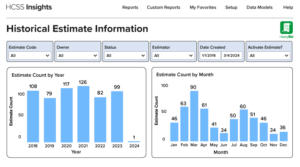
HCSS Insights takes this field data even further, giving everyone a clear picture of cost performance across jobs, crews, and time. Full dashboards showing real-time project information, so you can make the right decision…every time.
Bidding Volume is Surging for IIJA Projects
If you thought bidding was competitive before the Infrastructure Investment & Jobs Act, wait until you realize there's still $136 billion available for allocation in 2026. In our current high-volume bid environment, it's more challenging than ever to land consistent projects.
While top estimators get more efficient, those in the losing bracket continue to rebuild their estimates from scratch every time and need to manually recreate cost structures from old jobs.
If we've learned one thing from IIJA projects, it's that fast, accurate estimates keep the team fed.
Secure More IIJA Funding with Accurate Estimates
When bidding on highways, bridges, and complex DOT jobs, speed matters — but accuracy secures the margins. It's about submitting a competitive estimate while cutting out the risk of costly rework. HeavyBid helps estimators build competitive estimates using standardized templates, historical job data, proven cost codes, and workflows that make IIJA projects repeatable, fast, and accurate every time.
Beyond IIJA: Navigating the Proposed BUILD America 250 Act
Dialing in these repeatable, accurate workflows isn't just about surviving the final stretch of the IIJA; it's about building the operational foundation needed for the next massive legislative shift.
On May 18, 2026, the House Committee on Transportation and Infrastructure introduced the BUILD America 250 Act — a five-year surface transportation reauthorization covering highways, transit, safety, freight, and passenger rail. Four days later, the Committee voted 61-2 to advance it to the U.S Senate for approval.
 The legislation authorizes $580 billion over five years, including a nearly 25% increase in contract authority over the IIJA. September 30 no longer marks the end…but the beginning of some great opportunities.
Here’s what contractors need to know about it:
Bridges are getting the biggest federal investment in U.S history
The bill sets up a revised bridge formula program at $9.2 billion per year and adds $2 billion per year for a new Bridge Completion Program. Add it up, and you get a whopping $50 billion in bridge investment. Definitely a number worth writing down and putting somewhere visible if bridge work is in your near future.
The Surface Transportation Accelerator grant program comes in at $2.4 billion per year
New programs mean new bid opportunities, new compliance requirements, and new timelines to navigate. This new program consolidates and replaces several existing standalone transportation grant programs to fund multi-modal, safety, and economic connectivity projects. If you can move fast and document your performance, you’re set up for success.
The Highway Trust Fund finally get some new revenue
For the first time, the bill makes a real effort to restore the Highway Trust Fund (HTF) as the primary federal vehicle for surface transportation funding by imposing new fees on electric and hybrid vehicles.
That’s good news for long-term funding stability, which is great news for those trying to plan a backlog beyond 2026 and the 40,000+ new workers added to the industry during the IIJA funding era.
The federal government seems to be doubling down on infrastructure spending. The BUILD America 250 Act is the signal that the next five years of heavy civil work have a foundation. Now it's up to contractors to build their systems and speed up their workflows so they're ready for what's to come.
Laying the Foundation for the Post-IIJA Era
Federal infrastructure funding isn't going away, but the rules of engagement are changing.
More funding does not automatically mean more profit. The contractors who thrive under the BUILD America 250 Act will be those who replace guesswork with data clarity — from precision bidding in the office to real-time tracking in the field.
Now it’s up to you to build the systems to capture it.
Ready to see how HCSS can help you stay profitable through 2026 and beyond? Talk to one of our experts.