Hello, and welcome to this webinar, Unlocking Hidden Insights, the Power of Data Reporting and AI in Construction. This event is brought to you by Engineering News Record and sponsored by HCSS.
Hi, I'm Scott Seltz, publisher of ENR and your moderator for today's event. Thank you for joining us.
In today's fast paced heavy civil construction industry, the ability to collect, analyze, and act on data is more critical than ever. In this session, we'll be exploring how contractors can leverage data, reporting, and emerging AI tools to drive efficiency, improve decision making, and stay ahead of competition.
Today, we'll hear from Adam Black, Product Portfolio Manager of Operations at HCSS. After joining HCSS product team more than ten years ago, Adam led the efforts to modernize the HeavyJob platform with an emphasis on simpler user experiences for a steadily younger and more mobile workforce.
He recently helped launch ACSS Copilot, a modern AI assistant used by thousands in the construction industry.
Joining Adam, we'll hear from Michaela Halliwell, Product Manager at Data and API at HCSS.
Michaela has thirteen years experience in SAAS, specifically building API and data products in telematics, cybersecurity, nonprofit, and heavy civil construction industries. She hails from Denver, Colorado, where she lives with her wife, three kids, and three rottweilers.
To add to the conversation, we're also excited to welcome Jake Anderson, Regional Controls Manager at Archer Western. Jake brings over twenty years of experience in project controls with heavy civil contractors. He's a detail oriented problem solver and excels at building solutions to key organizational problems. Now I'll be rejoining the presenters at the end to field your questions that come throughout the webinar, so don't hesitate to submit them in the Q and A section of the webinar console during the presentation. And now I'll pass it over to Adam, Mikaela, and Jake to kick things off.
You everyone for joining us.
Looks like we have a lot of people here and we have a lot of good stuff to discuss.
We're gonna be going over some cool topics about data and AI.
Our objectives are to differentiate between data collection and true data driven decision making, identify some current and emerging use cases for AI, and then recognizing the common barriers to effective data usage before allowing you all to apply a practical framework for starting or improving your data driven strategies. But let's get into it. That's a lot of words. Let's just let's just dive right in.
So why does this matter now? I mean, I think that's one of the critical things is we are at an inflection point within our industry of technology and construction that we bring just coming together and really being able to provide, some new ways of doing things and making things more efficient.
So we're gonna go ahead and get started, and I think we're gonna start off with a poll.
Which best describes how your team uses data today?
And so we will let those come in.
Alright.
Numbers keep ticking, but it looks like we're seeing very similar, a nice little, diagonal pattern here going down through the options.
Alrighty. So this is actually an interesting one because a good, a good large number of you are using data regularly to make projects and business decisions. And, obviously, for those of you that are, the more data you have, the better your decision making can be. But it's getting access to the right kind of data and making sure that we don't make mistakes with it. So as we get through here, Mikayla, what are some common misconceptions about data in our industry?
Yeah. Thanks, Adam. Super excited to be here with everyone today.
I think you mentioned, but we're seeing this trend right now where we're relying less on our gut. We're relying less on experience and making more data driven decisions. But I think one of the biggest misconceptions is that just because you have a lot of data means that you're data driven. That's just not true, right? So construction companies collect tons of data time cards, quantities, equipment hours, RFIs, submittals, but it's mostly messy, unstructured, outdated, and hard to make heads or tails of and can actually be dangerous if you're just collecting data because it can give you a sense of false confidence.
Biggest one I think is just saying that, Oh, well, we have data, so we're data driven.
Another one I would say is probably that reporting or data is just for leadership, or it's just for executives or finance. It's really more than a top down exercise. The reality is that some of the most powerful insights can come from the field, right? Field teams want to do good work, but they need clear feedback loops.
If you give them clean dashboards that show production versus plan or job cost or burn rates, they're going to act on it. They're the ones turning the wrenches. They're the ones making the decisions. So don't hide data from them and empower them and give it to them.
And I think probably last thing I would say is that relying on your gut or experience or manual processes work okay because we've done it this way for thirty years.
But really, when those teams those teams are the ones that are gonna get crushed when a job goes sideways or when you're trying to scale.
Paper time cards, siloed Excel reports really can't keep up with the pace of modern business intelligence tooling. So data's either gonna help you or it's gonna hurt you, but hopefully not hold you back. I think those are probably what I would say.
Jake, do you have any thoughts around this?
No. I think what you said is very well.
No. I'll I'll add that.
Deciding what to do with your data is a big deal. Right?
Just because we have data and just because the data can tell us some things doesn't mean much.
We need to focus on what are our businesses' most pressing problems? What are our biggest challenges? Now let's go back to the data. How can we use that data to help us solve those problems?
Yeah. I think there's a there's a, like a pretty popular meme in the data world where it shows a bunch of scattered Legos, right, and this represents all the data that's available. And then the next images of Legos sorted and then Legos organized and this represents your data becoming collected and organized and then forming reports.
And then there's the LEGOs actually building something functional to put your pens in or building something that tells a story.
The industry, the tooling can do the reports for you, but the last, making it functional, making it applicable, and making those data driven decisions goes back on individual businesses. Right? And that puts the onus on them to actually do something with it. So having a lot of data, having reports doesn't mean anything unless you do something with it.
Yeah. Learned that I wanna touch on something you said I'm sorry. Go for it, Jake.
I've learned that there's a lot of problems you can solve with data, but like, you can't do everything. Right? So you want to pick your most pressing problems. It's start there. Get the most impact to your organization.
That's the mistake I find most people making. It's just because we see this data, we know intuitively we can get this from it.
Was that worth your time?
Is the impact it's going to make on your organization big enough to invest the resources in developing that tool?
Absolutely.
I was actually going to touch on the point Michaela that you mentioned about using your gut versus attempting to put a little more process around from a data perspective. I'm sure there are more than just me out there that actually likes operating using my gut and going with you know it kind of feels right like I know there's something there but obviously there's an issue with it because that's going to work in the perfect scenario when everything just aligns and you know exactly what you need to be doing and you know exactly where that problem is and then that then how to fix it.
But there is an issue with that is in the imperfect scenario is where we were having issues that being able to rely on more of a structure being able to actually point to where the data is leading you is going to be able to to make sure the decisions are being made correctly later on.
And so for those of you like myself that we're not not necessarily offended by the concept of not using our guts but just need more encouragement as to as to look at things just a little bit more closely. Just keep focused on those things.
Alright. We have another poll here regarding data.
What is your biggest challenge with using it effectively?
And we did not add a fifth option on here of I don't have challenges my data is perfect it's always updated effectively on time. There's never any issues.
I just look at it and it just beautifully makes If anybody answered that I want your number because I want to talk to you about how you solved that one.
Yeah. By all means put that in the chat for us so that we can get some advice on you. Get some advice from you.
All right. Looking at so very high in the lead there of our data is fragmented across systems.
Not surprising at all, is Not at all, no.
Well, what do we do to take those data that's coming in? How do we get from gathering it probably in various systems it seems like most people and actually being able to do something with it? Mikayla what do we do there?
I mean, that's no surprise. Right? Number one issue, disconnection. You've got data spread across multiple systems that don't talk to each other. You got timekeeping in one app, job costing in another, equipment tracking in a third, and that really makes it hard to get a single pane of glass view.
The reason for this is just how software has developed. In the 80s and 90s, companies dealt with a lot of monolithic mainframes where data is centralized but isolated. So data is across different systems. And then you move into the two thousands and the two thousand tens where you have more client server architectures and businesses are ensuring more consistency across their applications, but still you've got mobile apps and web apps.
And now today, where things are trending now, you have ecosystems, so integrated platforms, microservices.
So data integration is improving.
Companies are contending with data quality still, but across these different software eras, you're starting to see a unification effort of data sources, improving the reliability of data that's collected, making informed decisions, and cross product reporting. APIs are one of the most commonly used. They account for, I think, eighty five percent of web based activity, and so you have systems starting to talk to each other.
So what do we do about that? We continue to improve. We continue to get better. We continue allowing systems and partnering with each other to make sure that those those disparate systems, those fragmented systems no longer are are developed in silos, but that the the software world is now moving towards one big, more matched up system where you have things talking to each other.
That way we have less loss of trust with data. Right? We've got a lot of a lot of people who've been burned by, hey, this this doesn't match over here. How can I make sure the numbers match up? APIs are a really good solution going forward, better reporting, and then making sure we're continuing to climb out of this hole of, you know, lack of trusted data and making sure our systems are talking to each other more.
Jake, what do you think?
Yeah. I've I've seen some scenarios where we couldn't couldn't find the data or get our arms around the data that we wanted that we needed to solve the problem we were trying to solve. And so we had to go back to the beginning and adjust the way we were collecting data.
But Jake, what are some of the what do you look for from a collection standpoint of looking at different tools to make sure that the data you need in the office, let's say, is actually being found in the field. It's actually being entered in and it's being entered in a good way. We can ask the guys in the field all day long, hey we need this information but how do you go out making sure that A) it doesn't take up their entire day gathering information you need versus actually doing what they should be doing?
How do we make sure that's easier for them? How do we make sure it doesn't take up their entire day? How do we make sure that you're getting the right information you need?
Yeah. A a fair question. So from my perspective, gathering data shouldn't be painful for who for the person that is putting it in. If it is, you've got the wrong tool.
So you might need to make some tool adjustments if you wanna get the data that you're after.
But then if if you're having problems with you think you have the right tool, you're still having problems with gathering the data consistently. Now you might wanna gather some data for managers about who's faithfully getting you the data you want and who isn't. That's an actionable insight right there.
So let's say your your big objective is that we need to improve our safety record by, you know, an x percent or whatever whatever measurement you're using.
You may wanna measure who's engaging in your safety culture and who isn't. And that's something we did. We could tell our managers in the field who was engaging in our safety culture, and we actually figured out a way to measure the quality of their engagement as well.
HSS helps us with that.
And I think you're absolutely right. It's trying to figure out exactly what we want to be measuring. What should we be focused on at any given point? Because honestly all the data in the world is out there for you. Like it is there. The question is just choosing and prioritizing what together and then putting that into a system that's going to enable you to do the reporting, do the review that you need to do.
I should add maybe that we decided that we were going to make engaging in our safety culture a part of your performance review.
And so what management needed was an objective way to look at this, not gut or feel. Right? I want objective data about who is engaging in our safety culture and who isn't, and we're gonna score it.
And and that's what we did with the help of HSS. It was it was pretty successful.
And so now you can see who's engaging in safety culture, who isn't. You know, management knows who they have to go talk to about their engagement and safety culture and and who they should reward for proper engagement and safety culture. And then it also was tied to performance.
Cool. Very cool.
Michaela, you talked about this a little bit, going through some of the real-world barriers that we have.
Is there anything more we'd like to say? Obviously fragmented system seems to be a big deal for people but how do we get around some of the other barriers that you have besides just being able to put everything together in a system like HSS Insights or some of the other systems that are out there but how do we get beyond that and actually look at some of the other barriers that there are out there?
I think this comes down to a culture thing as well. I mean, you've got organizations out there that like to tout that they're data-driven, but it really comes down to asking the right questions. Right? So you might have a I like to ask five questions when we're trying to solve a problem.
Like like Jake said, figure out three big questions that you're trying to answer for your business, and then ask five questions to drill into that. So for instance, one of the questions could be, are my projects making money? So from there, you wanna create reports that compare estimated to actuals and figure out, no. My margins are actually low.
Okay. Second question.
What cost categories are responsible for driving overruns? So now we have to go make a report that looks at labor, equipment, materials, subcontractors, and say, wow, my labor is high. I wonder why that is. So why? Third question. What is causing it to be over budget?
Break down what cost codes are costing more money and then figure out, fourth question, what's impacting our productivity? Is it delays from RFIs? Do we have a lot of equipment that's down?
Are we reworking projects excessively?
Okay. Maybe that's that's the answer. So fifth question, what process improvements can fix the issue? That's data driven. Right?
It's not merely just collecting data and and throwing you have to ask the right questions in place. Right? And so from that, you can make the process improvements. You can fix scheduling. You can improve field communication. You can develop more training and reduce those inefficiencies better. So drill into the problem with that data.
I think that can solve a lot of the headache.
There's also, like I mentioned before, loss of trust in data.
And so if the data isn't being collected correctly or if it's inconsistent, you have reports that don't match the job site.
A lot of that data could be static as well and you're not regularly doing this.
So if your team doesn't believe in the numbers, it's gonna they're gonna stop using them and it's gonna fall off pretty quickly.
So I would say keep that culture consistent, train people on how to collect data, how to ask the right questions, and you're going to see a big change.
I think definitely think that's some great advice there.
All right. I think we are going to put data to the side for a second and talk a little bit about AI up next but there's some good questions that came in and we're going to hit those towards the end of talk this hour.
So our AI polling question how familiar are you with AI tools in construction?
Let's see.
Interesting.
This is not too surprising to see the middle boxes being checked here a lot A tie between those the second and third option there somewhat familiar and then curious just starting to explore which is why you're here today right?
One of the things we want to talk about is actually just getting into from an AI perspective what is available where things are starting and where things are going because obviously this is a brand spanking new technology that we've been experiencing over the last year or two.
Right. How AI is being used today. All right.
We're just really getting started. We're only really getting into what is possible with this stuff and we're going to see a lot of changes over the next couple of years. So let's talk about it from a today perspective. We're seeing a lot of chatbots.
We're seeing a lot of the ability to just go back and forth with the computer which is new for us. I mean yes we've been able to search and we've been able to type in questions and stuff like that. But one of the big changes that have occurred over the last let's say two years with LLMs and chat GPTs and other things like that are the ability for the computer to actually understand us better. And that's weird for us.
For those of us that grew up in an area where you had to know exactly what you're doing on the computer in order to get the response that you wanted. All right. If you didn't program if the computer wasn't programmed to take this question that you asked and respond the right way the odds of you getting the right answer were very low and that's changed. And that's an amazing thing.
It really is. And if you take nothing else that has changed at all from us the ability for the computer to understand our question is truly groundbreaking. And in and of itself is going to change a lot of how we do things. All right.
Now what else is out there for us? We have shopping assistance and report generators.
It's simple things where once again it's about the interface. It's about how am I talking with the computer and how is it able to give me the information that I need.
We're no longer and I'm at let's let's choose a website that people have that everybody's use. Let's choose something like Amazon or a standard shopping site that you're on. If I'm going in there and I would like to buy a new cup new thermos where's my camera? All right.
I could type in orange thermos. I can type in orange cup and it in the past has basically gone through a list of little tags and other things associated with all the products in Amazon looking for cups and looking for orange and it's looking for them in the title and it's looking for them in these tags or looking for them in the description and it's going to attempt to sort those And then Amazon does some cool things that Google originally started doing twenty-thirty years ago which is attempting to rank by how other people have chosen when searching for the same things. But it was all based on those search terms.
And now we're able to actually step away from that which is you tell something what you really want. I really need a new heat and cold proof cup preferably in my favorite shade of orange.
It needs to have a straw and most importantly to me of anything else the darn thing needs to be dishwasher safe because hand washing this every week which I will confess not to hand washing it enough It can be a little bit of a pain. Right. I need something dishwasher safe. Now I could literally talk that into something or I can type all of those things in there and I don't need to worry about the format of what I'm writing or anything like that.
The computer is now able to understand that.
Okay that is where we're at with AI being used today. Okay that does not mean that it's not going to other places but that is where it's being used today. But let's talk about how that applies to our industry. Okay.
So you're using a software program on the computer and in your browser and you'll have be able to have a chat bot that's on the side of you. Let's say you're doing some and I'm gonna pick something at a heavy job that's from HTSS. You're doing forecasting. Alright.
You've got the information that's come in from the field. You got your big grid up there with all of your cost codes and you're trying to figure out exactly where the job's gonna end up.
And I won't speak for other forecasting softwares. Ours has like fifty to one hundred different columns that you could choose based off of how you want to forecast. And half the time I don't remember exactly how each of them works and what the calculations are.
But now I have something on the side that I can just go into. And so it's like I got my grid there and I on the side it's what is this cost of completion calculation? How is that calculated on there? And your copilot your chatbot will go oh well it's using the expected and the actual and then it's going to multiply that by how much is left and come up with this number which it then adds on this one divides by three and puts its left hand in the air and that's how we get our forecasting number which let's all be real is as precise as we can get it at any given point. And let's hope you know we've often debated actually putting grades on people's forecast to see how they got.
It's funny that as you get further along in the job your forecast all of a sudden get more accurate and less rosy.
Like you're starting out two months in and your production might be crazy but you're gonna hit that you're gonna hit where you need to be.
And so now you have other things available to you that can help you with those forecasts that sit alongside you. You can ask questions and it will be able to understand what you're aiming to do and actually can suggest different ways of doing things.
And that's where we're at right now. You're able to upload documents. Let's say a spec sheet for a project and say, hey, this is that Westdoor Port expansion that I got right outside my road.
Paving a new stretch of road. This is what the DOT gave me at seventy or eighty pages. Previously, that's living in a file folder or on OneDrive on SharePoint somewhere.
And now I just upload that in and now I can ask it questions. Now I can just say, hey, when exactly did they need this thing do by? Or what was the materials that the the actual specs of the materials that need to be used during the estimating process so that I don't need to go look it up it can tell me and it can provide references. It can actually say yeah on page thirty two it says this so that and let me confess I'm gonna go in there and double check it.
We are still and I want to emphasize this we are still at the double checking stage of our AI lives. Okay it is a great tool but you're still in the in the in still needing to be double double check everything.
It's just a safety measure to make sure that it understands you as well as we all hope it does.
So those are some of the cool use cases and those are like I said those are very simple but there are more and more things that are coming online. I know there's stuff that we're building there's stuff that other companies are building.
Actually I'm gonna move ahead to the next slide here. Where is AI headed?
All right.
The word agentic has been used a lot in the last year from a technology perspective.
I didn't know the word prior to this past year which means we probably shouldn't be using it. I'm not a fan of using just new words just for the hell of it.
AgenTic means to take its agency. It comes from the word agent. So if you imagine anything that can do something for you if you have a travel agent although the internet kind of made them less common twenty years ago but if you have a travel agent what is their job? Their job is to book a trip for you to give you options to let you choose which ones you want and then to book a trip.
AI tools are now becoming agents for you. You go off you give them a task and they're going to go off and work for you and then they're going to come back and let you know how they did. And hopefully they've had success. And most importantly at least what many groups are doing including HCSS is we're going to come back and suggest to you okay these are your results. Would you like us to actually do the thing you asked us to do? Is putting that into your hands is you are the final decision maker.
We're taking it further out of the chatbot and actually putting it into your workflows so that you can start doing things more efficiently, but still giving you control over whether the AI actually is going to be done and actually used to do the thing that you wanted to do.
Jake, I know y'all have used AI at at your company. What what are you using it for?
Yeah. We we partnered with big Fortune five hundred company. I'm not gonna say who, but and and this is not available in the public marketplace yet. But we had we built AI intelligence into cameras that we put on our our heavy equipment.
We would have a forward facing and a backward facing camera on every piece of heavy equipment, and and the camera was developed in such a way that it could identify a human body part apart from, let's say, another piece of machinery, someone in the traveling public, some barrier, right, some the ground. It could identify human body parts, and and it got so good that it it could actually identify people. Like, let's say, oh, that's George's arm, and this is Fred's leg. Right?
And, I mean, it was amazing. And so we believe that just in the development of this, there was a piece of heavy equipment in a very restricted area, and so he wasn't he was backing up. He wasn't looking behind him because he thought, I'm there's no way anyone could get back there. Someone did sneak back there and wasn't paying attention and would've we believe would've been run over.
The AI technology slammed on the brakes, stopped the piece of equipment, and then verbally told the operator, someone's behind you.
So we believe we we saved a life there.
But but more more than that, because the AI technology got so good at identifying people and human body parts, like in in just take a hot mix paving operation, for example.
Over the course of a day and a week, we realized that we were actually getting data about of your twelve person hot mix paving crew, this one and that one are the ones who are getting into areas where they could be harmed. Now, haven't been harmed, but they could be. So those two people need to be told, don't go here.
And we have pictures of it.
Right?
We have pictures of them in harm's way, and you can tell, oh, that's George, and that's Fred. And and he said, oh, George got into that area four times yesterday and three times today. And Fred got into that area, you know, this many times on these days. It's like, okay. Those are trainable teachable moments that are literally making our people safer, making our job sites safer, making it safer to do the work that we do. So that's what we see AI doing, and it's exciting.
So contrary to popular beliefs, the robots will save us.
Yes.
Yes. Those sound like perfect, perfect use cases for AI. Right? It's something that in theory should just be should be there to help the user help in this case the operator making sure that they're not gonna run somebody got you know that scares me and not having seen as many job sites as y'all have because I get to work here in an office only get to visit job sites on occasion.
The impact of that quite literally can be catastrophic and the ability for something to step in there and just once again and it's not throwing a it's not even throwing a in a an alert on the dashboard saying they're you know they're like stop or something like that. It's literally saying there is someone behind you. It is is making that transition from detecting that there's someone behind you and alerting the user in the form that the user is most readily gonna be able to accept. There is someone behind you. You know stop the darn thing.
That I think is really cool about what we're seeing with all these use cases.
All right.
I kind of want to jump ahead to the questions but I think we have one more slide here about actual changes. A lot of questions have come in and we're going to get start going through them. But let's talk about some of the actual changes that we can make today. And I think this is something that Jake has really hit on is pick one real world problem start from there. Start with whether it's your biggest problem and you want to go tackle something big first or your smallest problem you want to get a win under your belt.
Actually, how do you go and this says that we definitely recommending starting small but how do you go about picking the right problem?
Vikayla or Jake, how do you go about picking the right problem to solve from a from a data perspective?
So I'll I'll say that we we started really small in that we didn't really intend to start. We just realized there were a couple of things we could do.
Right? And and that turned into a department with a staff of three managing the needs of every silo of the organization and triaging who gets what resources. We live in a limited resource environment, and so I I don't know where, you know, your organization is, whoever's listening to this, but there are a lot of different stages of how you're gonna manage this. If if there is no effort to use your data and get better insights from your data today, start with something obvious and easy is my recommendation because it it opens people's eyes to what's possible around you.
And before you know it, within a couple of years, you will have more people's eyes to see what you can do, what they can do. And so they're seeing what you can do with data, and then they have their own good ideas. And eventually, you get to the point where your good ideas are the enemy of your greatest ideas, and you can only do some of your greatest ideas even with a staff of three. Right? So that that's my advice.
Michaela I say focus on those things that are low level low low effort and high impact.
Pick one thing that's gonna matter to the people who are gonna give you the team and answer that question.
And then you'll start to see the support from them.
What what what advice beyond starting small and picking that low impact would you give to a company that's just starting its journey toward these decision making?
You gotta have someone that's gonna be annoying about this. Right? You have to have a a a data champion. Someone's gonna bug everyone to get this everyone rowing the same direction. Right?
Standardizing the basics.
Start with, hey. This is how we're gonna name our projects. Hey. Make sure that you classify the the category on this equipment.
That alone, just standardizing how you collect things can clean up a lot of chaos.
Have that data champion do a data cleanup sprint once a month. Pick a system, say, time tracking.
Clean up duplicate users, bad job names, missing data, and you'd be shocked really how far that that will go.
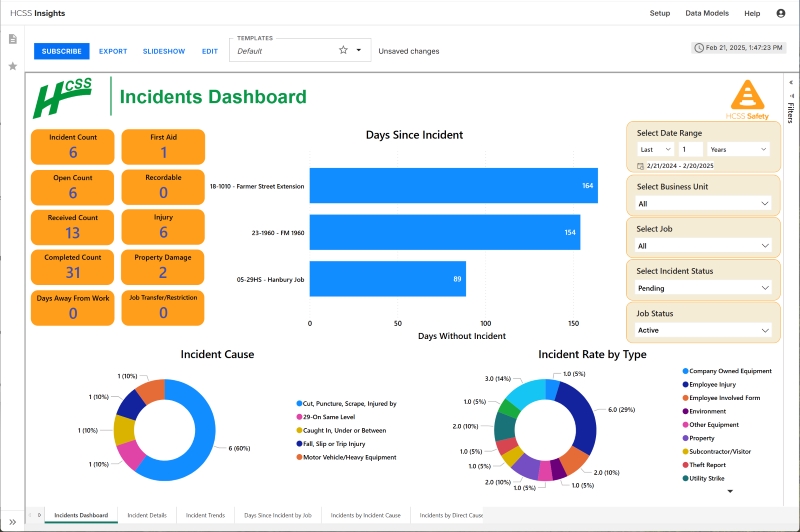
And then with that one question you're trying to answer, set up a simple dashboard for your field team, for your operations team. It doesn't have to be fancy.
Just pick one or two KPIs that matter, whether it's labor hours, production rates, safety incidents, and set the those to release on a schedule to the people that it matters to.
Follow through on it as well.
Don't just set it and forget it. If someone reports that there's an issue with the data, fix it. If there is a dashboard that's wrong or someone's not getting a report, fix it. Nothing is gonna kill a data culture faster than a system that no one maintains or no one trusts.
Yep. That's well said.
Very well said.
Alright. And I see questions continue to come in. So let me move to our webinar takeaways and then we're gonna get to the questions which I'm excited about.
But what are our webinar takeaways? Let's see when the office understands the field projects run smoother. All right which is really the reason for being of a lot of the different software out there is that office to field communication of making sure that the two stay in alignment.
Then one of my favorites when the field selects the tools they become powerful drivers of change.
We had one of our customers here at HCSS, big company that does work in the Northeast and four or five different states up there.
They actually when they were choosing HeavyJob ten years ago they actually gave iPads out to their foreman and they tried out six different programs. Six different applications and said, These are the six that are going to give us the data we need. Y'all sit there and put them through their paces. And to be honest I'm sure there were issues with all six of them.
HCSFs were fortunate enough that they went with HeavyJob but I'm sure there were issues with HeavyJob that they then went to us and like yeah that makes perfect sense. And we love actually hearing about when stuff comes from the field. But actually putting that power in the field's hand it gives them that empowerment that Mikaela was talking about of like this is something that we need. We need this data but we're gonna let you help us get there.
We're gonna empower you and you're gonna be part of that conversation.
Nothing worse than giving them a tool that isn't built for them. That's built for somebody in the office that doesn't know what goes on in the field and what they have to go through on a regular basis.
So don't do that.
Alright, the right day at the right time leads to better decisions in the field and that's that really is our circle right. Is the field is putting the data in there and it's flowing it up to the office but it needs to go right back out there to the field. And you don't want a tool or a system that's built to go one way only.
This is a two way conversation at all times and you need to be able to get the information back to the field because let's be quite clear and I get that most of the people on this call are like us. We work in offices a majority of the time. We're not on the field all that all as much maybe as much as we used to be back in the day.
But they're the ones that are need to be empowered to make the changes because that's where the change is going be most effective is the ones actually going out there and doing the work. And we have to keep the field conscious at all time which leads to the takeaway number four. As you invest in that field team today it will lead to the leaders for tomorrow at your company. And I'm sure there are plenty of people on this call that can speak to that personally Whether a member of their team or them themselves that were given that opportunity that were invested in when they were out in the field and now have continued to grow within your organization.
All right Q and A time my favorite time and the first one I'm going to throw over to Mikayla.
Understanding that data fragmentation remains a major issue largely because our industry evolved around point solutions and is only now beginning to mature into a platform and data centric mindset. Big question. To what extent do you think this fragmentation is driven by AEC tech leaders intentionally creating ecosystem lock ins for their users? And more importantly how can the industry begin to address or counterbalance this challenge?
That is a loaded question, but I like it.
AEC, for those who don't know, architecture, engineering, and construction, it is very complex, exacerbated by the fact that historically, we've relied on these point solutions rather than integrated ecosystems.
So to address your first question, which I think revolves around locking in on specific strategies. Right?
Advocate for open standards.
Adoption of standards that allow for more interoperability is going to provide better communication.
Promotion of APIs, my favorite thing.
Emphasize the importance of APIs. These allow different systems talk to each other and communicate, to share data.
Tech leaders should prioritize developing APIs, APIs that are easily consumable, APIs that are documented, APIs that support integration with other platforms.
And then along with that, APIs and partnerships should be in the same breath. If you have APIs that you intend to open up and integrate with other platforms, you should have collaboration and partnerships with the various tech providers and the different software systems. So partnerships that prioritize the user's needs rather than proprietary interests, Right?
So we're talking about things that reduce fragmentation.
And then just in general, increasing awareness about this, making sure that people understand these systems, how they talk to each other, what information is being exchanged, having training programs, having documentation around these initiatives can really help users make more informed decisions about what to buy, what they're going to invest in long term.
I think by addressing these, adopting APIs, adopting partnerships, encouraging collaboration, I think that we're gonna start to see fragmentation, start to go away and and and we have a more balanced efficient, ecosystem, that benefits everyone. So hope that answers your question.
Yeah. We were I I think it did. Yeah. Yes, Jake. Yeah.
Oh, I'm sorry, Adam. We I can I can remember a scenario where we were using HCSS data from HCSS Insights? We're using our ERP data. We're using data from our scheduling system.
We're using data from two other places. We were merging five data systems into one BI, and that that really helps break down some of those barriers. Right? I mean, as long as you can find some common factors in your data to link it together, becomes simple at that point.
And I think it's funny historically speaking at least my opinion and I apologize to anybody from an ERP system that happens to be listening on the call is we've not found them in the past let's say ten years ago to be the best about sharing data. They wanted to take all the data in. Didn't really want to give any of it out. But I think what we've seen what Mikayla's seen is being in charge from an API perspective at HSS is we are seeing a lot more of the willingness within the ERPs.
We have to work with all the ERPs because we got to get payroll out for y'all every week. But we're seeing a lot more willingness of the ERP systems whether that's anybody from you know QuickBooks when you're just getting started all the way up to JDE and CYC and those companies when you get larger is that they're a lot more willing now to open up APIs. They see that as a table stakes. It's something they have to do.
And so I would encourage you whenever you're talking to a prospective software provider is, Hey, do you have open APIs? Do you have something that is documentation that I can just look through and, Hey, I don't understand the documentation either. But I think the answer to that question is telling. Are they forthcoming?
Are they like yes we have APIs and here's the documentation. You can get whatever data you need. You can put like that's a good response that you want to be able to hear from somebody. Not a we'll we'll let you import it in from Excel occasionally.
But other than that, it's been locked down.
Don't even ask them if they have it. Say where is it?
Yeah. Table stakes.
Just just where is Where's your where's your AI documentation?
I'm I'm also laughing here. It looks like Eric was suggesting that that first question was written with AI.
So I have no idea it came in from a viewer so who knows?
But let's see Kyle here is asking how do we ensure that debt is consistently gathered? How would you ensure that there is standardization? Let's say we have three jobs all with different managers. What are methods you have seen work that can be implemented?
I'm gonna throw this to Jake first. I have an idea too, but let me throw this to Jake.
Yeah.
It comes down to managing human behaviors. Right? If you're having behavioral issues, you you need to not call it a data problem. It's not a data problem. It's a human behavior issue.
And then if your managers aren't managing your human behavior, then you need higher levels of management to manage your managers. If it's not a problem, then don't make it a problem. Right? If the data isn't important, it's not a problem. Data is important. If upper management wants something to do with it, then it has to be a problem, and you have to make it someone's problem.
That's how I would deal with it.
Lend transparency to the problem so that you can deal with the right people, right, which is what we did in that scenario I was talking to you about engaging in our safety culture. We wanted to expose those people who were not engaging in a safety culture so that we had actionable items that we could now give to our managers to go do what they do.
No that's a great point. It is. And think how I look at this we already talked a little bit about from the standpoint of you got to choose a good tool. A tool that the field's comfortable with that's built for the field and you got to start there. You really do.
And then from there you know there are some tools HeavyJob. I'm sure other tools have them too but there are ways of having the tool check the data coming in automatically. And that's once again it's basic checks making sure that the information that you need is submitted. But then it goes Jake as you were saying it's a people thing.
Let me just put it to you this way.
If you're expecting this data to come in so that you can run a report once a month and so you're only able to check and determine whether the data is correct on a monthly basis. You're not going to get the right data you need. You just aren't. Because you're caring about this once a month but you're expecting the guys out there doing all the hard work to care about it every day?
No no no no. That's not how this works. We have a hundred thousand time cards more than a hundred thousand at this point coming in every single day within HeavyJob. And we get in front of customers every day that we're onboarding and we're teaching them out.
And they're like yes you send payroll out once a week.
You do not get to approve time cards once a week. I'm sorry. Okay.
The foreman is expected to submit the time card every day. You are now expected to approve that time card every day. And yes the system allows some people to approve time cards on a weekly basis and we shame those companies. Like do not do that. Right.
All right. That is bad process. Okay.
You expecting the field to do something for your benefits on a daily basis. Check the data every day. Approve those time cards and be checking for the quantities coming in on a daily basis. Right and get back to them.
Like choose a tool that's gonna let you send something back and say hey that looks good or no there's something off about here let's talk about this because when they they see it two or three times that you're getting back to them on a daily basis all of a sudden they realize this is something you care about. And that is where you're gonna start getting good consistent data coming in is when they understand how important it is to you and it's not a monthly importance. It's not at the end of the quarter I'm running this thing and all my numbers are bad. Why is this?
No. It's a daily thing. So you have to make it a part of your life just as much as you're expecting the field to make it a part of theirs.
Yeah. I I do wanna tag on to that. I I slightly referred to this earlier. I just wanna wanna highlight it.
Do not let higher levels of management have it both ways. In other words, you call it a data problem. We have this problem. It's a data problem when it's really a human behavioral problem.
And they have managers who could do something about it, but they're not.
They can't be upset about the data problem when they're not upset about managers not managing. Right? I mean, you have to if they say, alright. I've I have now given you a tool so that you know who's not engaging or who's not doing what they're supposed to do. And if you wanna be soft about, well, that's Johnny, and we understand he's an exception. If that's the way you're gonna behave, that's way you're gonna manage, that's what you're gonna dictate, then you're not gonna have the data.
And and that's what you've chosen. Right? You can't have it both ways.
No. That's that's absolutely true. That's absolutely true.
Alrighty. We are getting let's see. What do we got here? Alright. Is the functionality of your Copilot also available on the Insights data model to explain how the available data fields were calculated in a data set? So yes you can ask the HCSS Copilot questions about how data certain data fields were calculated.
The cool thing about HCSS Insights is that Michaela's team is actually putting in new data sources like every week or two. And so keeping the knowledge that Copilot has up to date, it becomes trickier with the faster she's moving. But yes, you can ask you questions about how stuff is calculated.
And not only that too, but we're also working on updated dictionaries. I mean, the the the Copilot is only going to be as good as the information we feed it. And so we're working on where does this specific field come from in the UI and what is it calculating and working on report descriptions and table descriptions so that you can ask more in-depth questions about how this report is built, why is it calculated this way, where does this come from in the UI? All these things and then Copilot will be able to answer that for you.
Absolutely.
All right. Daniel's asking, I found the most value in AI, Claude project specifically by uploading our own customer company data in there and then working off of that data to get specific insights that apply to our company alone. If we had a place that we could upload knowledge from tenured employees that currently lives in their heads I think would be invaluable to new employees. The problem with Claude is the amount of data I can upload is limited.
Will HCSS eventually allow us to use AI to work with our specific data in job knowledge?
Yes. In fact you can do that today for what you're talking about.
Obviously we're continuing to expand and release new things but today you can actually you can ask questions about how your jobs are doing and it's gonna answer you and presumably the same vernacular. I've actually had fun trying to get our AI to talk like a pirate and tell me how my jobs are doing and it does.
You can also upload documents and I'm talking about company process documents. This is how we want to conform a bid. This is how you know the the Jake way of approving time cards and making sure everything is good because Jake has proven this is what we do. You just upload that in there and then it's available. Any new employee that starts or any employee that's not new and needs a little bit of help they're able to answer these things. And I promise you we're not the only ones that do this but like this is doable today. That's not something that's future that is a today thing that you should be able to do that.
Let's see and sorry questions keep asking stuff bouncing around on my screen. So Scott was asking how can AI be used for takeoff purposes to expedite the process? It's a great question something we've experimented with.
The key thing is in fact the key thing with any AI is what is the level of confidence in the answer it's able to give you. Okay. So unless that level of confidence is high 90s we don't want to put it in front of you at least from an HCSS perspective. We know that there's there's going to be a threshold that every company every software provider like we are feels comfortable in actually giving that to a user.
Our threshold is very high because we expect to be giving you the right answer. When you ask a question we expect to give you the right answer and that came out of our support department a long time ago is we don't give wrong answers. It's better to say I don't know. And the key thing is actually teaching an AI to say I don't know or this might be incorrect. And so what we play with takeoffs that's one of those key things we're actually getting it to read the visual the spec the drawings like that is more difficult than having it read plain text.
And so it's absolutely coming. I think we're going to see more companies able to do that in the next year.
But the key thing is getting to that threshold where we're confident in the answers enough that yes always double check at this stage of the game but that we feel pretty good about the answers.
Yeah and I guess that's going similar to Cole's question. In your opinion how far are we from AI being able to redesign plans and make informed decisions on them? So we've noticed that works well with text based documents with struggles with scanned PDFs. That's exactly what I'm talking about.
In fact if you scan the PDF and it's text then we're even better than we're okay. It's the pictures. It's the actual blueprints. It's the plan sheets that are just not easy in every case.
So that's where the stuff that we're going to be focusing on is going to come out of. And I think it's going to come very soon. The question is just when is it going to get there? When is that confidence level going to be high enough for us?
Definitely questions about future webinars on using HCSS insights or AI that we will get back with people whether individually or we'll just send something out and just let everybody know if they're interested.
Questions let's say is AI added to the legacy version of HeavyJob or only for web And what AI features are currently available in HeavyBid? So yes AI is available on the web but you can ask it questions about the legacy desktop version of HeavyJob. Very similar you can ask it questions about HeavyBid and it will answer questions about the desktop version of HeavyBid. Obviously we're in the midst of HeavyBid is going to the web which was announced several months ago and so we're already looking at AI functionality within there. It's very cool stuff.
Timeline for insights to join data from different apps and tables are already able to do a lot of that I think Michaela but for example data from tables and heavy job and three sixty.
Yeah you can do that today.
Awesome awesome Go with a final question here. What advice would you give to someone trying to be a data champion in a company that hasn't prioritized analytics yet?
Can I go? Because I think it's simple, really. We already kind of talked about it a little bit, which is pick something that's low effort, high reward. Pick something that's easy.
But then if you're like me and you're not a tech guy, right, I don't know how to write in programming languages and anything like that. I just know data. Right? I know how to leverage data.
But you could partner with someone like HHS, and they can help you build your first report, and that will start to wet the appetites of some people around you and open their eyes to what what can be done. That's my advice.
Yep. Leverage any of the eighty eighty three reports out of the box that are in Insights right now.
Absolutely. Alrighty, I think we've reached our time. We are at the hour long, Mark.
Thank you very much. And this has been a very great presentation. I want our viewers to join me once again thanking Adam Black, Michaela Halliwell, and Jack Anderson, as well as our today's sponsor, HCSS. If you had any questions that we did not get to during the presentation Q and A, we will give those to our presenters, and they'll follow-up with you via email.
If you didn't have a chance to fill it out earlier, you will be redirected shortly to a post event survey. We look forward to hearing from you on how to make our programs work better. Please visit ENR dot com slash webinars for the archive of this presentation to share with your colleagues, as well as information about upcoming events. We hope you found today's discussion a good investment of your time.
Thanks again for joining us, and have a great day.