
In a recent webinar hosted by HCSS, industry insiders discussed the changes in construction technology that have occurred over the past two to three years, along with what to expect in 2026 and the practical steps contractors should take ASAP.
From Buzzwords to Solidifying an Advantage on Jobsites
What’s different about construction lately is that AI and data are moving on from “the next big thing” label and becoming the new baseline for how contractors protect margins, scale productivity, and make faster decisions with fewer people.
In our discussion, we tackled a massive topic by attempting to unpack the technology shifts shaping the industry, including why adoption is accelerating (even when confidence is lagging), and what contractors can do right now to turn AI into practical operational leverage.
Let’s dive into some of the biggest takeaways we presented.
Beyond the Hype: The Rapid Coming of Age for Construction AI
One highlight of product experts across the industry has been the speed of adoption of AI tech. A few years ago, firms were “experimenting,” and now they are actively using AI in daily workflows. As the tools improve, the gap between “testing” and “scaling” is shrinking.
In a poll of hundreds of contractors attending the webinar, most described themselves as still in the testing phase with a few tools. A smaller share has begun scaling their efforts, while roughly one in four hasn’t adopted AI yet.
Joe Quattrochi, Director of Quality and Process Improvement at The Walsh Group, shared how The Walsh Group has moved through essentially all stages in roughly a year. They started out skeptical, ran pilots, and ultimately expanded into a broader, in-house approach.
At the end of the day, you don’t have to live and breathe AI to get value, but the longer you wait, the harder your organization is making it to catch up.

The Industry Pressures Pushing AI Adoption Are Not Going Away
Numerous practical forces are making AI “unavoidable.” These include:
- Labor shortages in the field and the office
- Margin pressure from competition and rising costs
- Inflation and geopolitical volatility, especially painful on long-duration jobs
- A flood of digital tools and data, creating both opportunity and overwhelm
Another key detail that’s important to mention is contractors aren’t asking for AI because they want to reduce their number of employees. The real interest in AI comes from a need to make the workforce they already have more productive (and doing this while keeping risk as low as possible).
This point can’t be underemphasized. At HCSS, what we mostly hear from customers isn’t about “replacing people,” but rather reducing the time spent on data entry, making data more accurate, and helping teams focus on better work overall.
The Real Problem: Adoption is Rising Faster Than Confidence
A genuine aha-moment came from a contradiction we highlighted: a minority of firms rate themselves as “above average” in technology advancement, yet a large majority are already using AI in some form. That tells you something important: the barrier isn’t whether AI is being used; it’s whether people trust it, understand it, and can execute it safely.
Digitization = Automation? Yes
AI doesn’t live in a vacuum. It's the next phase of a longer wave: digitizing paper processes (laptops, iPads, field capture) that are evolving into automation that reduces manual work.
Two enablers have made this shift possible:
- Better connectivity (5G, satellite, expanding broadband)
- Cloud-first workflows where field and office share real-time environments
That said, there’s a major pain point among contractors right now: there are too many apps, too many logins, and these systems are largely disconnected. No organization wants to go on a scavenger hunt to figure out which tool has which answer. While many vendors claim they “integrate,” real-world integrations are often expensive and/or ineffective.
As the user experience becomes more efficient, it only makes sense that strategies will involve consolidations. Contractors want platforms that talk to each other, ultimately reducing the number of systems workers must learn.
5 Ways to Set Up Your Construction Business for AI Success
Successful AI integration isn't about the software you buy, it's about the foundation you build. Here are five strategic moves to ensure your business is ready to scale:
1. Start with people and process, then technology: Don’t buy AI and figure it out later. Identify workflow pains first.
2. Target manual, slow, disconnected workflows: Anywhere a human is acting like a computer is an automation opportunity.
3. Invest in data quality and standardization: Better AI outcomes require better inputs.
4. Train early, and treat training as risk mitigation: This isn’t to be looked at as overhead, nor should it be optional. This is how you can scale safely.
5. Adopt AI where ROI is obvious today, and build toward bigger wins: Document workflows, reporting, and scheduling are strong starting points.
The Bottom Line for 2026
Here’s a dirty little secret: most “AI” isn’t AI. Currently, vendors are throwing “AI” on everything to take advantage of a cool buzzword and sell more products. Many of these “AI” tools are just rules-based automation dressed up and marketed as AI.
That said, don’t let this deter you from finding a construction software platform that can truly serve as a solution to your daily challenges.
AI is poised to transform construction at a faster rate than in previous cycles. For example, the cloud revolution took a while to change the way a jobsite works, but we’re not on the same time schedule for AI influencing the way construction companies work.
Data analytics and real-time decision-making are going to change construction. What will drive the analytics and AI revolution is data entry, data quality, and consistent capture systems. Construction firms that start early will have a huge competitive advantage.
Be Sure to Check Out the Complete AI Webinar Below
Ready to learn more? If you want to chat about your business needs, speak with a product expert today.
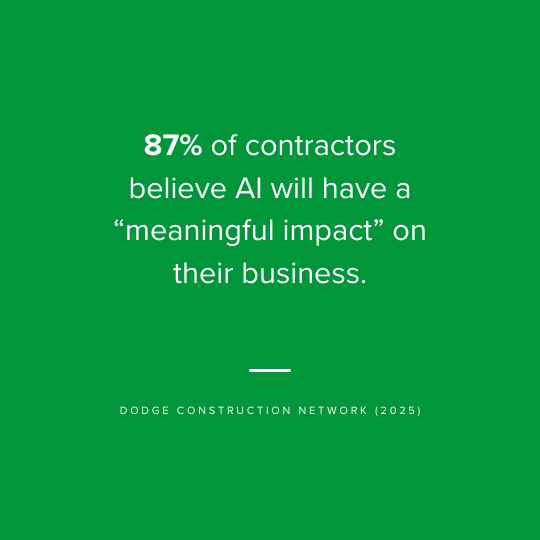
Thanks for joining us today. We're gonna talk about AI and data and the condition of the industry and technology and how those two things are coming together to drive construction contractors in twenty twenty six and the next several years. So I'll start by introducing ourselves. My name's Allen Hurst. I'm senior director of product at HCSS. So I help run our product management teams and our product planning and delivery process. I have a technology background. I've been in construction technology for about ten years, but most of my career has been in software and software services across a variety of industries and companies in different shapes and sizes. So I'll I'll represent the tech side of this. I've asked our friend Joe from Walsh to join us to give us more industry insight, and I'll let him introduce himself. Hello, everyone. Joe Cotrochi with The Walsh Group, director of quality and process improvement. With The Walsh Group, we do heavy civil building, water treatment plant work across the country. Our office is kinda all over the place, and I kind of lead our water transportation side of things along with the technology and process improvement side of things. Been in the industry twenty two years all with the Walsh Group and happy to be here today to kind of bring in some contractor insight to where we are and just what we're seeing with throughout the industry. Thanks for diving in. We're gonna start today by talking about major the major technology shifts that are shaping construction today. Next, we're gonna we're gonna talk about AI and data and how we're at the point where we're our industry is moving from buzzwords into how we actually apply those technologies to everyday workflows. And we'll talk about data and analytics and real time reporting and how important those are to operational decision making, especially in the next several years. I and we'll close-up with some practical steps that the contractors can start taking now, not one day, to help them stay more competitive. So digging into the the first topic, AI is kind of is coming coming of age. We're seeing as far as tech the technology adoptions moving from hype to kind of rotting into broadening into early majority adoption, There's a Bluebeam survey that's that showed that about twenty four seventy four percent of AAC companies are already using AI at least one phase of their projects, whether it's design, planning, estimating, construction, or construction. And there was a Dodge Construction Network report from twenty twenty five that showed that eighty seven percent of contractors, believe that AI will have a meaningful impact on on their business. So there's it's not, in an early adopter category technology anymore. It's kind of it's a mainstream expectation. And and we've seen adoption increase not linearly, but kind of exponentially. We saw AI adoption and construction. Maybe twenty three percent of firms in twenty eighteen were, were using AI or or experimenting with it, up to thirty seven percent in twenty twenty three, and now, the majority. And so it's we've seen that double just over the last couple years according to the SOM CIRT, data that was recently released. And there's a variety of factors influencing that that we'll go into over the next hour or so. But AI really didn't suddenly get interesting. The environment has just made it unavoidable. So we're gonna do a poll question next to discuss where where everybody in the audience is today, whether not using AI at all, whether you're testing and experimenting, or whether you're actively scaling adoption. You know, kinda use this to help frame the rest of the discussion. We'll give a few more few more minutes for folks to answer. I think we got a few on behalf of you all, few more minutes. Take your time. Okay. I think we can start to look at results. I think. Okay. I think we're seeing results now. Just might let me know in chat if you're not. We're seeing this. So among people who just responded, the the leader is we got folks testing a few tools. Maybe a very small percentage that are actively expanding that across the business and, you know, maybe a quarter of folks that are that are not using it yet at all. So that's and that's that's consistent, I think, with what I have seen. Joe, I don't if you have any comments of where you all are on this journey. Yeah. For ourselves, we kind of went through this whole all four of these stages just within the past year or so. Initially very skeptical and didn't want to be able to have a bleeding edge, but have gone in to done done some pilot testing about a year ago that's fully expanded with a small group of individuals to kind of help see where the use cases were and that's fully expanded. So now we're fully going in with with in in house solution with one of the providers, that's gonna be available then across all the workflows, that we're already kind of building in. So kinda just within the last year, I've gone through the whole whole realm of this from one end one end to the other. Okay. We'll move on, I think. Okay. Why don't you keep going, Joe, and tell us Yeah. Yeah. So part part the reason, with with our switch and and it's gone relatively fast, it's just that we've been seeing the changes in the industry. Know, start with the obvious on labor shortages, not just labor shortages on the trade field side, but we're also seeing it in the office, the staffing side of just having good qualified people at in every place. So anywhere we're able to find efficiency in workflows, which we're already seeing through AI, that's going to help us try and maximize the good people that we do have to make sure everyone's doing what and doing to the best of their abilities. But labor shortage is definitely one of the main drivers across the board I think we're all seeing. From the you know pressure on the margins obviously increased competition and you know depending on the marketplace that you're in definitely a lot of opportunities in some marketplaces to see to be shrinking. Definitely diversification on that side is definitely helpful for contractors there. But overall, we're seeing a lot of opportunities out there. Rising costs from whether it be inflation and geopolitical factors out there is potentially causing issues especially on those longer term jobs not able to pass it along to the owners quite as openly. But just with these new marketplaces it's just created opportunities where we just need to be able to get into that. With the additional data that's now available that's being collected with all the different softwares that are out there and everything that's becoming digital, it's all made it where we've kind of seen the need that we had to make the switch into the eye realm in order to leverage it. We have the information there, the salute, you know, all this information digitally and what we've then seen through some of the pilots be able to kinda leverage it is what's kinda helped make us push our shift. Yeah. Yeah. It's in so the we hear in the in the news and and in general around how AI is decreasing, decreasing cutting jobs and decreasing the need for as many people, with the what I've what I've heard from our customers is that not so much that is a desperate need to make their existing workforce more productive. And so the the requests we get for better AI tooling and more integration of that into our software is really around that goal. How do we make our people as effective and productive as possible and and leverage these tools to do that? Great. One of the interesting things that that we've noticed is kind of a as insecurity around the how folks adopt this technology. So only about thirty percent of firms rate themselves as above average in technology advancement, and that's actually been going down over the last several years. But yet, eighty three percent of them are already using AI. So that that contradiction is kind of is telling us something important, that the adoption is rising faster than the confidence. And it's an execution problem, not a tech problem. It really comes down to trust in these tools and and trust that they're leading us in the right direction. So talking now a little bit more about technology shifts. So we're still riding a wave of digitalization that has been going on for a long time. At HGSS, we've been trying to be push this in the industry and and kinda guide our our our customers toward, digitizing paper processes. We started by pushing laptops to the field and iPads to the field. And now we're trying to move from or help leverage AI and data analytics to decrease the amount of data entry and and move, that toward data verification. So capturing and automating as much of data entry as possible reducing the amount of time and clicks that a a user has to spend in software so they can focus on their job. But as we've been on this journey over the last fifteen years, we've seen that broad broadband availability expand, especially due to things like five gs and satellite that's been able to accelerate really quickly, which is enabling our customers to use more cloud tools, have more live data, and create cloud first workflows, where field and office personnel are working in shared environments with the same access to real time data, and paper is really disappearing quickly, and digital is the default for all information. But not every job site is connected still. So we at HSS, we're balancing balancing that. Like, how do we make the best, most modern tools available while still enabling the disconnected job site and having a fallback, a manual fallback or, you know, disconnected fallback. But papers, in general, become, not just inefficient, but risky to a business. You have any comments on that, Joe? I'd say it again. Like you said, the broadband expansion definitely has been a benefit, and pretty consistent across the board now. On the digitization side of things, you know, for being as large of a company we are and advanced in many ways, we were still on paper time sheets as of a year and a half ago. And just it was due to being the size that we were that it took us a long time to be able to make that transition into a fully digital system for payroll processing. It's been great, and there's been other avenues that we've been on a digital side for years. So I kind of just share that as a while it's great to go all in and totally get rid of paper across the board, it doesn't have to be an all or nothing scenario. You can kind of pick or choose a process as a, hey. This still makes sense in paper. Still a lot of form, and that's still no matter what we give them, they still want their drawings on eleven by seventeen in a big booklet, and that's the only way they're ever gonna look at them. So still have to be able to manage those paper necessities where you need them. But, obviously, the more you're able to put digital, more you're gonna be able to do with it down the road. So on the back of those advancements, we see that the rise in automation. And so automation today isn't really about replacing expertise. It's about enabling that expertise by removing repetitive and time consuming and low value work from those folks. So those tasks are increasingly handled by software and AI agents and even early assist early AI assisted document processing and scheduling, and we're seeing we have customers seeing an ROI in that. We're also seeing consolidation. Platforms. Larger platforms are absorbing niche niche tools because those contractor contractors want fewer systems, and they want those systems to talk to each other. So we're seeing deep more deeper more deep usage of fewer tools with a preference toward connected systems. And we're companies need to mitigate concerns like data security, the lack of training, and familiarity with these AI tools inside their workforce, and also just employee buy in to that. So trust matters as much as capability in terms of these AI tools. Yeah. But consolidation is a huge one for us. One of the biggest complaint that we get from our job job site teams is there's just so many systems. I don't know where to go for which, you know, which thing I'm looking for. I just need a road map just to figure out what app to open. So definitely consolidation is a definitely something everyone should be looking at to while every tool seems to say, well, I'm the best at doing this one thing or this one thing. Like Alan, you said, being able to use a tool for the breadth of elements helps create more standardization, lot easier for things to talk to each other because many of the systems that say oh I can I have an API and I can talk to this system and that system that system, yeah maybe in a perfect world they could but not necessarily how you're using it or you don't you know it's additional cost to set that up that don't really want to go that route? Kind of understanding how everything actually works together and trying to ultimately you're trying to make these technologies work for your people. So understanding that what's their limit of the number of the systems you really want them to learn goes a long way. I have another poll. So take a few minutes to to pick a choice for this one. As we're discussing barriers to adoption, this is we hear these things a lot. So I'm curious how how these present for your companies. Can I click all the above? Yeah. That's probably the right answer for most folks. Alright. So looking at the results of this, questions about ROI seems to be seems to be leading, which is a great question because we ask ourselves we ask ourselves a lot as people that are building these tools. You know, we've had lots of great ideas when we get into R and D, find out that, you know, this this this isn't really helping or or the quality is not high enough or or things like that. So you've got problems on the tool side, and then you've also got problems on the internal side. Like, what is the what what is the internal expertise? How how quickly are those folks, even if they are aware or or educated on the tools, how much will they be resistant to adopting them? And, so we'll dig into these a little bit more as we go through the rest of the presentation. Thanks for responding to the poll. Yeah. The one interesting thing I'll say on that, interested on those results. For us personally, data security is probably the number one barrier at this point in time. And part of that is just there's stories and news all the time of, you know, different companies getting hacked, this and that, you know, data you know, data breach to crypto scams and all that that's been coming coming along. So I mean, having a good data security support program definitely hugely beneficial across the board. In fact, every software that we look at before we even try to use it, we go through a pilot program where first one of the first things is we go through and check the data security. We got a handful of things that we always go through with our IT group just to make sure, hey. This is a company that we wanna make sure that we understand what's going out with the data, where it's stored, how to use, what happens if it gets broken into, things like that. So that's one of the first things that we look into, before we start utilizing anything that's out there, and kind of maybe tied to the other elements. Part of the reason for that is probably for the five years prior, there's been so many different technologies that are being used that it's create a lot of internal experts on individual systems for individual things. But then we've realized that, well, Jimmy knows all this about this one software, but we got another two thousand people over on the other side of country that have no idea that software exists. So we have that internal expertise but being able to share that across the board to make sure everyone actually leverages that software especially before going out and buying another software that does the same thing has been an area of concern. So trying to ratchet that down, but for us, it all comes back to the security side. One of the most, one of the threads that we that we see when we're having conversation with folks trying to figure out, how to best leverage, AI and data, is that AI has been a really an accelerator of data analytics in general. So there before AI existed, it was difficult sometimes to make sense of all the data or that that we were collecting, and to understand how to use it. And what AI is as we've decreased the gap between being able to get data and being able to use it, what we find is that now that we can use the data more effectively, the data also has to be of high quality, which is which is a challenge. So better better decisions start with better data. So increased leverage of sensors and telemetry, telemetry data, in photos, audio, and video. This is a a data volume that we've been collecting, but now that data needs to be better so that it's more useful for us. But we've seen across a variety of different industry studies that high performers are doing these things. They're using historical data. They're benchmarking their jobs. They're forecasting earlier and detecting variants earlier. And we really can only leverage AI on data that exists already. And so analytics maturity, usually precedes AI maturity as a necessary component of AI maturity. So companies have to move from after the fact reporting and static spreadsheets to continuous visibility, predictive signals, and scenario modeling. What are you doing at at, Walsh, Joe, to improve the data quality, that y'all are getting into the into the office? Yeah. I I guess first before sharing that side, just to kinda push a little more on what you're saying, you know AI is great at filling in the gaps and trying to come up with an answer or whatever you're looking for. So if you take a bunch of bad data, you give it to AI, it's still going to give you an answer. It's not going to tell you this data is bad. It's still going to give you an answer, it's going to connect the dots in whatever way it assumes you're trying to make it. And quite often we found that whenever you take a lot of unstructured data that doesn't have good quality, it's giving bad results to us. So having that, you know, the the importance of having good quality data is huge from a take it from a cost control side of things. Know, that's typically very structured data with cost coding systems, you know, time sheets, payroll processing, that's always been pretty well structured data that goes into how we all cost report looks like. And that's something that's been very good of utilizing data systems like Power BI to kind of analyze that and show the data in a different way beyond just what our cost report looks like to make sure that you're maybe seeing indicators much sooner to be able to act faster. What one thing that we found though is that when that when we don't have standardization from how we are coding the work to how we bid the work, kind of creating that loop around has definitely been an issue and don't have that apples to apples comparison of how we're bidding versus how we're actually doing it in the field and using that historical data. So that's definitely helped of now better structure or standardizing from the HSS heavy bid to what we're doing in heavy job and having the more consistency sort of flows right on back. If you have that set up you're already ever seeing that benefit from it. Then from safety and quality side of things, for years we've had in house systems of kind of tracking incidents and inspections as we're going along. And while we're getting some data of the count and cost and who is getting injured and body parts, there's only so much we're able to do with it. Now again with ATSS safety and tracking everything through there, it's more real time, but we're also able to tie it to individual crews, foreman, cost codes so that we know the actual activities that were happening during the rework or during the safety injury or first aid, and that's allowed us to now trend the data a little bit differently that when we know we have a bunch of work going on a you know whether it's structural steel or underground drainage pipe, we now have data history to show all right well here's the predictive of a chance that there being an incident or being an accident with this work and that's helped us so much now as we started going to that. Now it's taken us quite a while to do that and it's a lot of cleanup of our old data, but we're quickly seeing the value of it now with kind of tying in that AI side to help us be a little more predictive. Another trend, that's influencing the way, we are thinking about data, is the real time nature, of that and how how that continues to be more and more necessary. We used to have maybe, reports that were have data from the previous day, or even reports that are hourly are now not good enough. Folks want up to the minute reports, and they want those dashboards to be live updating rather than something you send around an email on a weekly basis. And that pressure comes both internally and trying to make data driven decisions and run an effective run an effective job site, but also coming from owners. There's increased pressure for accountability, more compliance, more audits, more safety requirements, and more tracking and documentation. So, there's pressure all around. It's all comes down to better data and more real time data. But what's cool about the technology that's associated with this, that it's really democratized access to this information. We don't just have, not the it's not just the biggest companies in the industry. It's not just the ENR top fifty or whatever, that, that have the resources to make this happen. Those tools are really in the hands of anyone that wants to invest the time, and attention into making them effective. I think Joe, you wanna tell us about kind of reality versus hype and how you've had gone from, like, maybe experimentation to adoption of some of these AI tools? Sure. So I'm sure everyone here is getting cold calls from different vendors saying, hey. Are you you know, we got this AI here, AI here, AI Europe. Probably three quarters of the time, they're saying the words AI, but it's not actually AI. So that's definitely something that we've seen that everyone just wants to talk about because they think they're just gonna be able to make money off it. Definitely be skeptical of vendors and that saying that they're actually using AI. It's not always the case And it's something we saw very early on, people are starting to jump on that bandwagon real quick, but when you actually start seeing how they were utilizing it and some of the details within, you're like, no, you're just putting a couple pieces together, but this isn't ultimately gonna provide any value at the end of the day. So as we've gotten more into it between testing out the Gemini and JetGBT and co pilots, they're out there and seeing some of the vendors that were truly leveraging in the right way. Initially, first concern was security and governance. All those companies have been very clear that anything you upload, anything you say, it's public. It's going to be there forever because that's how they are training the model and that's why all those systems are free. They want the information because that's going to make them better at the end of the day. So that is the difference between the with that paywall of kind of doing a private or corporate account with a chat sheet, here that You're at least putting some firewalls in place, and that's been one of our biggest concerns is whether it's one of those main players or once the outside vendors. Anything we put in there, what's happening to it, where's it going, how's it gonna be utilized was one of our biggest concern and a big reason why we really didn't move forward with anything until we knew we had a good plan with a trusted partner that we knew our data was going to be handled correctly in NAPA. No concerns on that front. So that was our main hurdle to get through, then as we've been testing it, it's really been the data quality of it and a lot of it you probably heard the whole idea of a prompt engineer that you know with AI, again you could ask a question ten different ways, you're gonna get ten different answers when there's really only one correct answer. And it all goes into how you're asking the question, what you're asking the AI agent to act as, how you want them to respond, what you want them to use this context, that all plays into it. So we put a lot into now creating kind of agents or little working areas of hey if you're looking for information on construction work planning, go here. If you're looking into cost control questions with AI, it's here, schedule is here. This way it's using the right context information. A simple example is in the realm of things like doing a submittal review. If you were to try to take a submittal and upload into one of these systems and say, hey does this meet the spec? Well unless you specifically tell what job, what spec, what section, it's simply going to find any spec where it does meet, so yep it meets. So kind of so that's been one of the issues with the the reliability and I'll say the skepticism side of things is that everything that comes out of it, it's going back to it. Are you sure this is right? Because still half the time if I asked it one plus one, sometimes I don't get two. So making sure that it's confident in its response, providing the sources for its response is definitely something we always are training our people on how to use. That kind of goes that last symbol there on the skeptical workforce. Construction workers at every level are usually hesitant to change in their ways. We saw that in the response to the one poll question. So helping show them the value, show them the real life use cases have been very helpful, But it's taken a lot of training and kind of simplifying what you're asking them to do so that they're able to see the more consistent response has shown a lot of value. Yeah. I think that that low adoption of technology and construction is not not really because of ignorance. Right? It's because the margins are thin. The risk is asymmetric. Some mistakes are really expensive. And there's been tools that have historically and continued to promise more than they've been able to deliver. And and so it's really top of mind for us not to fall into that. We wanna make sure that the tools we build are not hype. Right? There's across not just in construction, but across technology in general. We've got a lot of vendors that are putting AI capabilities in their tools as a way to justify price increases without necessarily delivering a lot of a lot more value. But the customers that are adopting it, you said, do have those do have those concerns. And once you get over the adoption, you still have issues with sixty percent of folks who report issues concerns about data security. Fifty eight percent have concerns about, really leveraging the tools effectively or or well enough to justify the ROI because their tools are expensive, and they're not gonna get cheaper. And we've already talked about, like, the data quality issues. So it's important that we recognize that AI is not gonna replace expertise. It's gonna replace typing. So, we should, lean on those tools, but not necessarily but ask use them the right way and for the right things, right, on an attempt to, sort of attempt to replace, human experience and human human thought. Yeah. The phrase we use is, you know, AI can write a letter for you, but AI is not gonna sign it for you. You're still gonna have to sign it, so you better make sure whatever AI wrote for you is a hundred percent right. Alright. So but as far as folks that are using it, how are they using it? We've seen that seventy percent of folks are looking into it for contract and document review. Sixty five percent are using it for information accessibility. Sixty percent are using it for process optimization. So that just continues to reiterate the point that we're in a shift from data entry to data verification enabled by these tools. Humans, like you said, still remain accountable, but AI can remove some of that clair drag. Next, we got one more well, more than one more poll question. Well, we got another poll question, I'll give a few minutes to make some choices here. And this will help us understand where AI can deliver the most immediate value to you all to your organization. And it's also useful for us internally as we have products that address each of these areas where we should be be doing the most R and D. Fifteen seconds here. So Okay. Yeah. Estimating your preconstruction. It's not a surprise that that's the winner. And there's a few reasons for that. One, it's heavily numbers driven, which and data and analysis driven. It's also done in the office. Like, tools are available to us and already kind of using PCs from day to day. And, adopting control, another area where there's a lot of input coming in, where people are having to pull information from one data and source and put it in another another system. So there's it's right for automation. What are your thoughts on these results, Joe? You got me? At least consistent with what you expect? Yeah. Yeah. I mean, the estimating precon probably will have the most benefit. You know still waiting for that one system where you just upload all the drawings and specs and it gives you a number. I don't think we're quite there or will be there anytime soon but definitely a lot of potential there and then the scheduling is the other one that we're looking into more of how be more predictive on the scheduling side of things, ensure we're focusing on the right elements. You know, the doc control reporting and even cost control, think are easy items of immediate return on investment with with AI and those elements. And I think those will be the initial ones that we'll see a lot of a lot of AI tools pushing on those sides. And that's areas we're investing R and D into. It's, as we've gone through experiments and estimating on the estimating front, how can we pull, AI capabilities into heavy bid? This these these threads run through that. Right? We have to we've been evaluating those experiments based based on their quality, based on accuracy, based on comparing the the output from a automated AI estimator to a expert estimator, just so we can tweak and tune those systems to make sure that if we put something we put tools out there in someone's hands, that they're gonna be able to rely on them. They're gonna be able to have trust in them Because there's a you don't get a second chance at a first impression when it comes to people using these tools. We wanna make sure we get it right. Okay. As far as what what to expect in the short term. So let's we see things so we're going from AI experimentation to AI operational or we're operationalizing it now. So it's less about adoption, more about scaling. It's less about, using ChatGPT on your phone, more having those capabilities in context of the tools you're already using, or changing tools based on availability of tools that are better, that do have those integrated capabilities. Data quality and our interoperability is is really important. Data that lives isolated from all your your other data is far less viable. And you're losing the benefit of an AI system that can make connections to data that would have taken a lot more effort for humans to to make. So there's there's definitely creating incentives for folks to get data integrated. Standardization over ad hoc. One of the ways that we get better data is by having more standardization of practices and more consistent data collection patterns, so that, the day is a high quality. And kind of throughout, we see, AI as creating super humans instead of replacing humans. Joe, do you have any comments on what the ROI what the r is the ROI for y'alls in in adoption of these tools? Is that these items on the bottom there? Yeah. I guess, John, the last comment made though, do wanna say, I don't if I said it before, but it really needs to go back to focusing on people, process, then technology and technology always need to be third in that realm. That's what your people need, it's how it works in the workflow and then how you bring in whether it's data, AI, outside tech softwares, and just always remembering that. It's not just trying to figure it out. I bought AI now. Just gotta figure out where it fits in. If you're looking at it that way, it's ultimately that you're gonna have issues somewhere else along the way that's not really gonna work for you. As far as the returns that we're looking for, it's on how we're gonna keep our people safer. So being more predictive of on the potential risk and hazards. So our foreman on the field know it as soon as they start off their day and they're going through their pre task plan. They already know what hazards are going to be in front of them based on our own data, based on the job site and what information is there. It's less rework whether that's in the office or specifically in the field kind of through the same thing through the different inspections and more real time data on that front then ultimately helping us be more profitable work ahead of schedule and trying to dive in all the way from the estimating side and leveraging from that front to the scheduling and cost control measures to make sure that ultimately all of this is working for our field teams. Okay. I think this is the last poll over number. Right? So let us know what you think on on what your immediate next steps are as far as AI adoption. Going? Okay. Heavy heavy investment in data analytics and AI and automation, which is appropriate. One requires the other. So if we able to kinda combine those two into one, so the vast majority of what folks are doing there. And we'll come back and let's let's folks answer ask questions about this stuff too. Think this is probably pretty good material for us to dig into further based on what people's interests are. But back to immediate next steps. So there are areas where where workflows that are still manual slow are disconnected. That's a good candidate for automation. And we can't do that without closing those gaps. So we need to to to train teams early and often. There's access to these tools is foundational. So, getting getting the tools in the hands of of your workforce and enabling them to take advantage of those, is a first step toward operationalizing and scaling, AI adoption. So we have to see customers, figuring out the details of that. So back to comments Joe made about data quality, data consistency. Those things come in as soon as we get the tools in people's hands and and start to, start to teach them how to use them. So, that's another thing that contractors can do now to prepare for this revolution. The more investment we you have in data quality, the more likely you are to be able to capitalize on those investments when the tools inevitably improve. And we'd encourage folks to go ahead and adopt and apply a or or AI where the return on investment's available for you. There are anytime a human's acting like a computer, it's an opportunity for the computer to step in. So any automation around documentation tracking, scheduling, and then kind of in the in the longer term, gathering more jobsite data, gathering more safety data, safety observation datas. So this is the more the more leading indicators we can find and gather without folks having to do data entry, the more likely we are to be able to have predictive analytics to keep job site incidents from occurring. Joe, do you have any comments on on what the what somebody coming out of this call can do today or into, you know, in the start of the year to move their AI program forward? I think kinda as you laid it out in those steps, I'd hate for people to try to jump towards this of start testing things out and try to move forward with, you know, different systems and that prior to having some of the foundational elements. So kinda how you had the prior slide kinda taking that a little bit in order before you actually start adopting something. By all means pilot test, you know, find the the smartest youngest kid. I'm sure he's probably already using ChatGPT on a daily basis for himself. Ask them, get feedback from them on how they wanna use it. Again, go back to the people, the forum and the superintendents. What is it that they want in a perfect world and see then how AI can fit into that workflow. And I'll go back to the training side that you've got to train the people regardless of it if you're still doing paper to whether using digital form, ultimately how do they need to be filling those things out and getting the right information so that you can ultimately leverage information? Even if that's not gonna be for a year or five years from now, the better and earlier you start on getting that data quality going, the better that's gonna help you in the long run. Yeah. Training investing in that training early requires some mindset shift. It's not just overhead. We gotta see it as risk mitigation and enabling future data driven decision making. And so that's the ability to factor that training into, into job schedules, is is a strategic investment that those folks need to figure out a way to to match. Okay. Let's go ahead and get to the takeaways. So we have some time for q and a. So so changes is accelerating. If we think back to where the AI tools were a year or two ago, we're in a dramatically different place. So use your imagination to think about what that could mean for the next couple of years. We may not recognize the state of these tools two years from now compared to where we are today. So it's gonna change construction faster than in previous cycles. The cloud revolution took a while to change the way a job site works. I don't think we're on the same time schedule for AI influencing the way construction companies work. So at this point, we're moving from AI as a as a trend, as a buzzword, to a business, essential to a construction business and then to our planning. So firms that stay on top of that and start early are gonna win in a space where that's driving, driving performance. And if you don't take anything away from this other than alright, focus on how data analytics and real time decision making are gonna change, construction and how data entry and data quality and consistent capture, is gonna drive that analytics and AI revolution. And the folks that do that well are gonna have a competitive advantage. I guess now we'll move into q and a. And I'm not quite sure how to handle manage that, so hopefully someone on our side will Yeah. Looks like we have a few questions. One is what kind of AI based workflows can we look forward to with HTSS, especially on the heavy bit side, such as abilities to establish ROMs based on historical data, utilizing past estimates, or automated takeoffs? Yeah. It's a great question. So we are actively experimenting. We have teams running experiments on how we can accelerate, let's say, not automate the estimating process, but accelerate the estimating process using AI. So and and so that starts with the inputs to to the estimate, whether it's and a lot of that's bid lighting documents or plans and being able to process those documents and pull the most important information out so that we can prefill estimates with, with data that doesn't require someone to read and move move data from one document to another. And then provide that agent, that's creating that estimate information on the the context that it needs, whether it be DOT data or, previous production data, to inform those those numbers and and make them available so that we're not replacing estimators. We're helping existing estimators become informatically more effective. But we it's not just estimating. Right? Documents are used throughout the workflow. So we've got smart documents research going on in Leap, for how we handle, automating entrance of entry of preventive maintenance schedules or something like our parts lists. We're using it in operations to to manage RFIs and submittals, to manage, materials tickets coming in from a job site. So we've got experiments going on across the board in kind of that the smart documents arena. That that's one category. We've got, like, six different categories of AI tools, that we're looking to build, from any kind of those document driven workflows to what we're calling magic commands. They're smart helpers that will show up in context of what you're doing rather than having to jump run run to a chatbot to ask a question. Those insights are made in the context of what you're doing right now on the screen with the data and and alongside it. So, in kind of getting into future, we'll we wanna factor more of that industry data into our decisions. We wanna pull that into reports. We want proactive alerts that, don't require someone to run a report to find a connection between some data, but put that in front of you real time as it's made available. So there's a variety of different experiments there. Yeah. Looks like the next one we have is for Joe. What are a few real world use cases AI has helped your company? What did you use and what did you do? Good question. So some of the early elements that we're pushing in so simple one is similar to review. By isolating contract specifications, drawings, created avenues so that users can upload submittal and not only does it actually do the review but actually gives a checklist to say all right the spec says it needs to hit these full things and here's how this submittal package hits those twelve things or maybe where it's falling short and shows you the individual pages. So kind of gives you an individual checklist that then the user is able to go in, vet out, verify before processing. From a work planning side of things, we're using AI to help denote potential risk, hazards, as well as mitigation strategies. So for activities as simple as creating and pouring a sidewalk to installing a retaining wall to doing tile floors by simply uploading some specifications drawings again keeping that isolated versus just using whatever YouTube video you find on the web by isolating what information it's using along with we're able to use a lot of the data we have on past safety injuries and quality rework incidents that it's able to then pull that data to say all right based on your history here's some things that happened before in this type of work and here's things you should incorporate into your plan to help mitigate that from happening. So those are the two initial ones that we've really been pushing out and leveraging now starting to get into things like scheduling where we're able to compare our CPM schedules to our daily and look ahead schedules to help make sure they're truly matching up that we're actually working on the things that our CPM says that we need to be working on. But especially on a large job that's got a three hundred page CPM schedule, that's where AI has been able to help kind of leverage that mass knowledge to kind of do that analysis for us to help us stay on top of that versus trying to do that line by line analysis. Similar on cost reporting, kind of doing the same thing on that. Those are the few initial ones that we're looking into or have already started leveraging. Awesome. Now we're getting quite a few questions specifically about how HCSS is moving down the world of AI. Would they wanna know if we have any road maps or if we're working on anything regarding fleet management tools and if our data can be life fed into Power BI? Yeah. Good question. I'll try to take try to each of those. We we will have road map guidance for customers in especially UGM. So we'll be able to answer lots of questions if you're coming to to UGM. If you're not, you're still under, I believe. And then on our road map site, we're still finalizing twenty twenty six road maps over the course of the next few weeks. So as those become available, we'll put updates on our roadmaps dot h t s s dot com site for folks to to look at look at those. And I guess it's let me make sure that that's right. So there'll there'll be access to that there. And customers that have annual business reviews, if there's specific questions you have, let let your, the folks in our enterprise team or our customer success team know, and, they can get in touch with our product team, for for specific questions. But there are a couple more points in there. Brooke, if you don't mind reminding me of what they were Yes. In that question. One was if we are doing anything for telematics related. And another question that actually just popped in was what roles, such as project managers, supervisors, do we think would benefit most from learning and using AI in the construction industry? Okay. Telematics workflows primarily are we've been looking into bringing that data into other decisions. So how can we use data from, from telematics or, OEMs, to factor into how we think about, maintenance schedules or how we think about, equipment maintenance, how we think about, estimates. And that's part of providing as much context as possible to those expert assistants. There's also a question, I think, about Power BI. So we've seen as we launched Insights last year, we've seen a lot of increased usage of that and a lot of demand for custom reports. It's teaching us more about what we need, what customers want out of a reporting tool. And and we really see insights as a way to get information from across your business into one place to let you gain insights from it. And so that that's driven off of Power BI. We also have customers that are using our APIs or our direct a direct access offering to pull data into their own warehouses or their own ecosystem, and I've been putting a padded Power BI or Tableau or whatever on top of on top of that. So there's depending on how you wanna engage or how much control you want over that data, we have a variety of of tools available for that. And specifically about roles. Right now, work work office workflows are close to closer to the cloud, whereas field workflows have a few extra steps, either connectivity is slower or unavailable. And we're still kinda waiting for Apple and Google to make some on device AI APIs available. I hope that over the next twelve months, we're keeping a close eye on, on how Apple and Google are are allowing on device, on device AI and what we can do with that. But but even with the tools that we have now, you know, we we definitely have a field first mindset. We wanna enable the field. We think that's that's where the efficiencies are gonna come. So we're not ignoring, the field user even though, yeah, those project managers and estimators, probably have the most immediate use cases. But those may not be the highest value ones as we look, you know, several years from now back at what's really made a difference. I'll add something real quick there. One of the other use cases is again by warehousing the project specific requirements in one spot, have scenarios where foreman superintendents out in the field can ask a generalized question. Hey I'm about to pour a slab on this building, remind them what was the mix design for it and it will source that information again out of the whether it be work plans, specs, drawings for things like that. So instead of them finding a specific page of that, it'll give them the answer along with the source. Here's where I found that from available check. So helping make that flow of information back to them much quicker and easier. Looks like that's all the time we have for q and a's. We'll get out we'll work on getting these answers to you, and we'll also share a recording of this presentation with you in the coming days. Thank you all for attending. You can see our speakers' contact information here if you have any specific questions, and keep a lookout for the webinar recording. Thank you so much for attending. And be all the days and break.