

100+ JHA templates or customize per job
Choose from hundreds of industry-specific JHA forms to quickly identify hazards, calculate severity, and inform about best practices for hazard control.
Easily walk through JHA
Make sure all PPE, primary hazards, step list, controls, and equipment are correct.
See what HCSS can do for you
Schedule a demo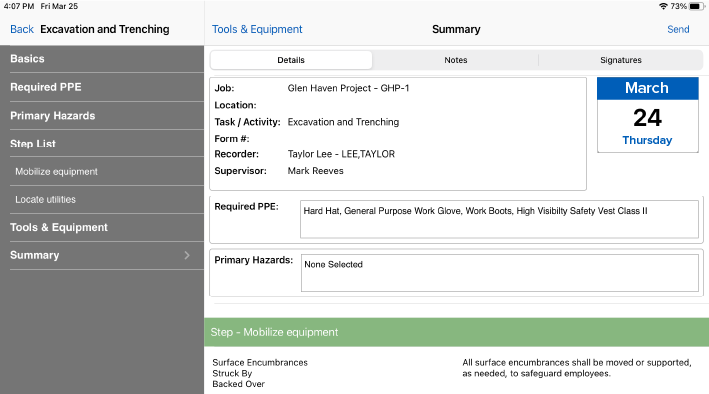
Ask our customers why they trust HeavyJob Safety for JHAs and JSAs







It’s the best JHA in the market.
- Jake Anderson, The Walsh Group
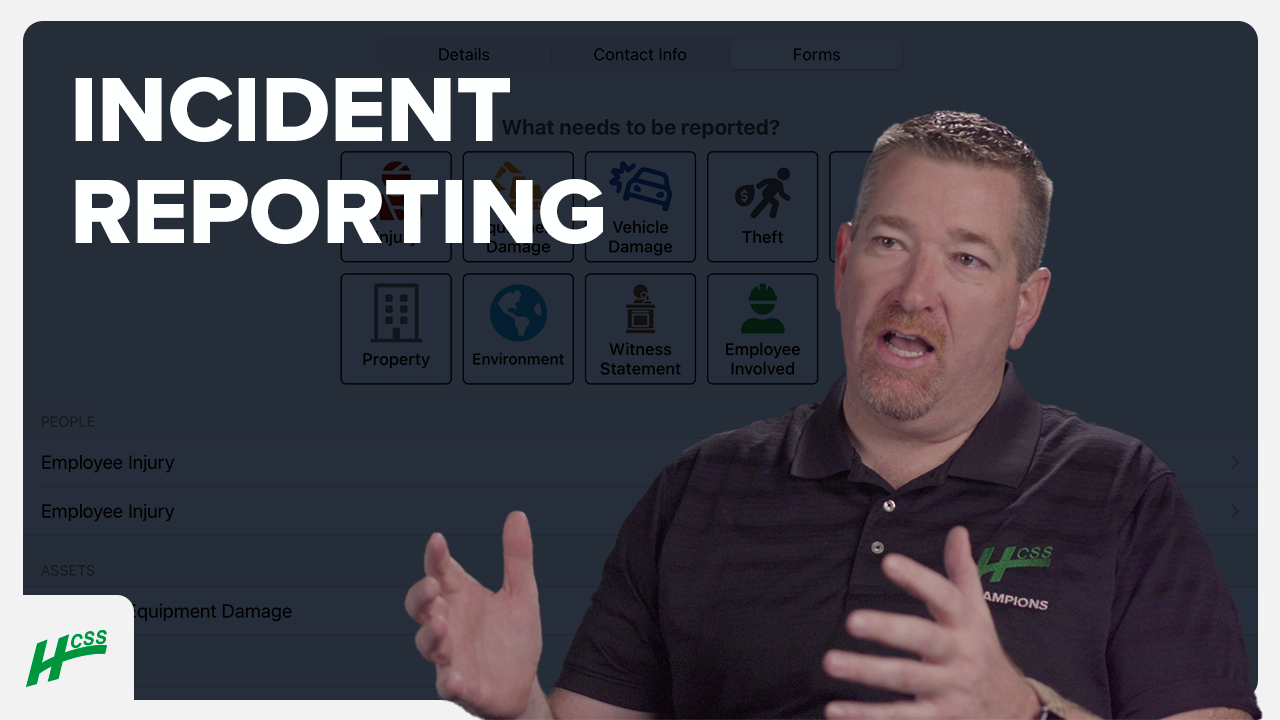
Since using HCSS, our EMR has dropped.
- Chris Albright, KE&G Construction
96%
lower reportable incident rate for HeavyJob Safety users than the industry average
1.5 million
inspections completed in 2024
9.0/10
average user rating
Always-on support.
Always human.
- Guided implementation to get your team up and running faster.
- Award-winning 24/7/365 support from our Sugar Land, TX office.
- Dedicated Customer Success rep to guide you beyond go-live.
- Ongoing training through HCSS Academy and HCSS community.
Protect your people and your productivity
Step 1
Share your business headaches
After submitting a demo request form, an HCSS expert will follow up with you by the end of the next business day to discuss your business needs and requirements.
Step 2
See HCSS in action
Then, we’ll walk you through a demo tailored to specific HCSS solutions that can help solve your current business problems.
Step 3
Get up and running in days
Finally, you’ll be assigned a dedicated implementation specialist who will manage your implementation from start to finish and ensure project completion.
Frequently asked questions
What is a Job Hazard Safety Analysis (JHA/JSA)?
Job Hazard Analysis (JHA), also known as a Job Safety Analysis (JSA), is a systematic process used to identify potential hazards associated with specific job tasks before they begin. In heavy civil construction, where environments change daily, a JHA breaks a task down into individual steps, identifies the risks for each step (such as trench cave-ins or overhead power lines), and establishes controls to eliminate or mitigate those risks. Digital JHA software ensures these critical safety plans are documented, shared, and acknowledged by every crew member on-site.
Why is a JHA important for construction safety compliance?
JHAs are a cornerstone of OSHA compliance and a primary tool for “General Duty Clause” adherence. By documenting that a crew identified risks and implemented safety measures before starting work, a company creates a definitive audit trail. This documentation is vital during safety audits, insurance renewals, and incident investigations, proving a proactive commitment to worker protection.
Can I create and customize JHA templates for site-specific risks?
Yes. Heavy civil work is rarely one size fits all. HeavyJob Safety allows safety managers to build a library of customizable JHA templates tailored to specific disciplines such as paving, blasting, or confined space entry. These templates can then be modified by the foreman in the field to account for site-specific variables like weather, nearby traffic, or specific soil types. This ensures that the JHA is a relevant document rather than a generic checklist.
How does JHA software improve communication between field crews and supervisors?
Digital JHA software bridges the communication gap by making safety a collaborative, transparent process. Instead of a foreman keeping a paper log in their truck, the digital JHA is accessible to everyone in the field and the office. Field crews can sign off on the JHA directly on a tablet, confirming they understand the risks. Meanwhile, supervisors can monitor compliance in real-time, ensuring that high-risk activities have a completed and approved analysis before work commences.
Can JHA software be used for pre-task planning across multiple crews?
Absolutely. HeavyJob Safety is designed for coordinated pre-task planning. On large jobsites where multiple crews (e.g., dirt, utility, and structures) are working in close proximity, JHA software allows for project managers in the office to create a pre-task plan that helps mitigate hazards when multiple crews are working in close proximity.
Does the software support linking JHAs to specific equipment or activities?
Yes. One of the unique advantages of HeavyJob Safety is the ability to link a JHA directly to a specific cost code, equipment type, or daily activity. For example, if a crew is assigned to “Bridge Pier Pour,” the software can automatically suggest the relevant JHA for working at heights and concrete placement. This ensures that the right safety information is always in front of the right people at the right time, reducing the administrative burden on the foreman.
How can JHA data be used to identify recurring hazards and reduce incidents?
This is where safety documentation becomes predictive intelligence. By aggregating data from thousands of JHAs, HeavyJob Safety provides analytics that highlight recurring hazards across your entire company. If the data shows a high frequency of “trip hazards” or “pinch points” identified during utility work, safety directors can implement targeted training or change procurement standards for equipment. This data-driven approach moves your safety culture from reactive (fixing problems after they happen) to proactive (preventing them from occurring).
Didn’t get all of your questions answered?
Request info